USA Today bestselling author

Tag: wolves in the wild

Of Wolves and Men

Of Wolves and MenOf Wolves and Men was written shortly before I was born, and small parts of it are dated. However, the overall theme of the historical human relationship with wolves stands the test of time.

My favorite sections involved the intersection of Native American and wolf culture. Both two-legged and four-legged hunters would stalk antelopes in Wyoming by lying low in tall grasses, twitching their tails to draw in curious prey animals. Elsewhere, both wolves and people hunted bison by chasing them out onto lake ice where they’d slide around and become easy to kill. And Lopez suggested that deer responded similarly to both wolf and human territories, sticking to the disputed space along borders where neither hunter was likely to go.

Another favorite part of the book was when the author recounted an experience tracking a wolf and a fox. The former had made a kill alone and was preparing to cache the meat it couldn’t cram into its stomach for later, but the wolf knew a fox was hanging around waiting for scraps. So the wolf traveled in crazy loops, hopping through puddles and generally going to great lengths to hide its trail before digging a super-secret cache.

The fox got the meat anyway.

Other tidbits: I was intrigued to learn that the metal spikes on dog collars were originally envisioned as protecting dogs against wolves. And howls may be used, among other things, as a “mood-synchronizing activity.”

I’ll let you dig deeper into the book yourself but will provide one warning. The third section is about human attempts to eradicate wolves and it’s a tough read. You might skip straight over that and head into the folklore near the end.

The Hidden World of the Fox

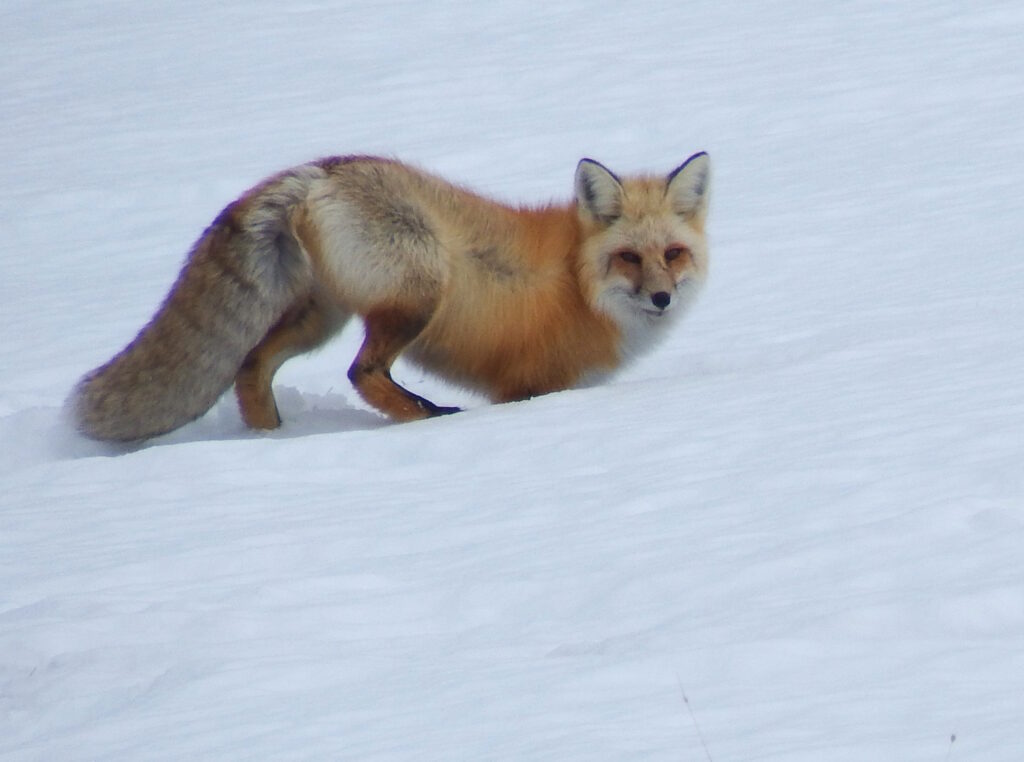
The Hidden World of the FoxAdele Brand’s book is a lovingly written, easy to read, but far from exhaustive window into the red fox’s world. Most the text is about the European foxes the author has had personal experiences with (which she notes are considered by some to be a different species than the North American red fox). Here are some of my favorite takeaways:

I hadn’t realized that red foxes in Britain have been folded into not-so-wild areas, both living wild in cities and fed in backyards the way Americans feed birds. (A different source suggests urban foxes are evolving to be more doglike than their rural counterparts, which is an intriguing corollary). This actually matches up with my anecdotal survey of fox populations in the U.S. — I smell them regularly during my woodland hikes while very rarely seeing them, but a suburban friend says they’re pretty common where she lives.

How (other than smell) do you know foxes are present? My friend often hears them (probably most frequently in midwinter when they’re mating) and sees them as roadkill. And while we think of foxes as nocturnal, Brand notes that they’ve just learned to be leery of humans and move their activity to night when we’re around. All of that said, game cameras will dramatically increase your odds of seeing a fox. Set the camera up about a foot and a half off the ground, pointing up a game trail (rather than across).

hunting fox

Brand goes on to explain that a fox requires “nine voles or one rat daily – or one double cheeseburger with fries.” A mother fox will need to add on two additional voles a day per cub. And since their stomachs are small, foxes can’t go long periods like wolves do between meals. Instead, they need to snack often, sometimes on earthworms or carrion (although rodents are their main prey).

The experienced viewer can tell male and female foxes apart by the shape of their faces. Vixens (females) have narrower faces while dogfoxes (males) have broader cheekbones that make their faces look W-shaped.

Brand writes: “Territories are really the construct of male foxes; a vixen, rather like a Victorian woman, holds property only as a proxy of her mate.” A fox territory is often home to a breeding pair, subordinate females who usually don’t breed, cubs from the previous year (usually female), and possibly a transient male or two.

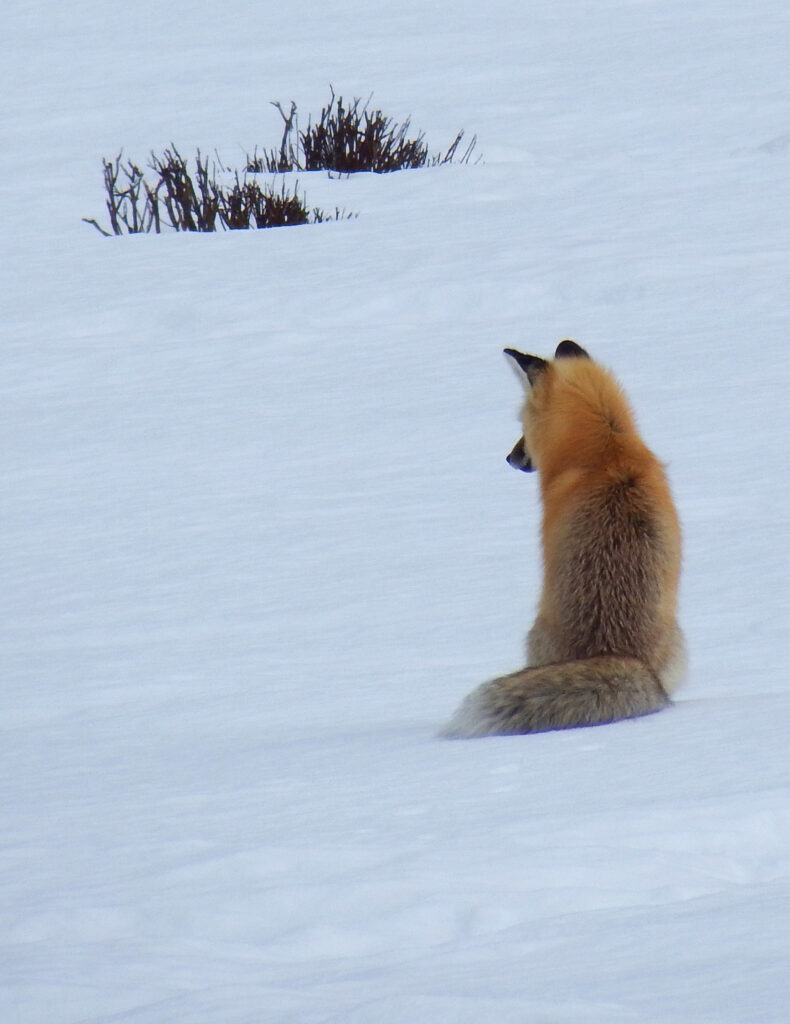
Sitting fox

Finally, I’ll end with an absolutely crazy story Brand told about a German fox who “gathered shoes to a fantastically obsessive level. For over a year, steel-capped workmen’s boots, wellingtons, and slippers all vanished from doorsteps. When a forestry worker stumbled upon her den, an astonishing 86 shoes were stashed around it. Another 32 were found nearby in a quarry. The count of the town duly had laid them out in his palace for their owners to collect – and put out a gentle advisory to keep footwear indoors at night.”

Intrigued? There’s plenty more where that came from, but you’ll need to read the book for the rest. Alternatively, you can read my far-more-fantastical take on foxes in the city in the free book Wolf’s Bane.

The universal appeal of shifters: A trope for every genre

Humans that morph into animals abound in stories of fantasy and romance and can even be found in literary fiction, science fiction, and horror. But which shifters appeal to which readers?

I have my own theories, but I thought I’d see how they stack up against real-life responses. To that end, I polled three facebook groups — one focused on werewolves in paranormal romance settings, one focused on urban fantasy in general, and one created just for fans of Patricia Briggs.

Alpha werewolves

As expected, the paranormal-romance readers were most united about their reasons for loving werewolves. 80% of them were looking for one or both of the following:

Mates — You could have guessed this one. Paranormal-romance readers love the idea of the one true mate, the fated mate, and/or the hot alpha mate. They’re not the only ones sucked in by that idea, though. 8% of urban fantasy respondents and 14% of Patricia Briggs’ fans also put mates at the top of their werewolf-book wish list.

Found family — This is one of my favorite things to write about (present in all of my books to some extent, but particularly in my Wolf Rampant series), so I know exactly where readers are coming from. A community of werewolves that comes together to create something larger than the sum of its parts is instantly seductive. Subsets include: pack bonds and lone wolves being drawn into a pack.

Werewolf pack dynamics

In contrast, readers in both the general urban fantasy group and in Patricia Briggs’ fan group rated a different facet of werewolf books most important:

Pack dynamics — We love the way the combination of wolf and animal traits create a complicated world full of drama, ritual, and infighting. In fact, if you add in the element of making human power dynamics more visible (overbearing alphas, sassy underdogs bucking the hierarchy, etc.), 20% of paranormal romance readers put this at the top of their list as well. I’ve found pack dynamics are particularly fun to tease apart when you insert a protagonist into a pack she wasn’t born into, as is the case in my Moon Marked series (and, come to think of it, in Mercy Thompson’s case as well).

Human/wolf duality

On the other hand, urban-fantasy readers were more interested than anyone else in this aspect:

The dual animal/human nature of a werewolf — I’ll let one of my respondents sum this one up since she said it so well: “The internal struggle between wolf/human. I think it is a good description of how complex humans are. We all have a wolf half or darker nature, if you will. And we all struggle to balance those emotions and desires.” I suspect this human/wolf duality that Lori Hughes so ably described (and which I put at the forefront of my Moon Blind series) would appeal to a horror audience in addition to a fantasy audience. If you want your werewolves to be forced to shift at the full moon, I suspect you’re tapping into this deep human conflict.

What’s left to love about werewolves? How about:

The wolves themselves — As Tina Hoefs explained, “I love animals more than people. Less drama and bs.” Other respondents mentioned how much they love wolves specifically. They particularly appreciated the scenes where protagonists ran in lupine form, although several also mentioned other aspects of wolfish behavior (either while two-legged or four-legged). Paranormal-romance readers weren’t strongly interested in this aspect, but about a quarter of urban-fantasy readers and a fifth of Patricia Briggs’ fans listed it as a must-have in werewolf books.

Finally, a much smaller subset of readers noted that their favorite aspect is:

General worldbuilding — Whether that’s werewolf superpowers or shifters interacting with vampires and other beings.

And that’s about it for what most of us love about werewolves. Except…maybe you’re attracted to something entirely different? If so, you’ll have to write an outside-the-box shifter novel and share it with the world!


Ravens and wolves

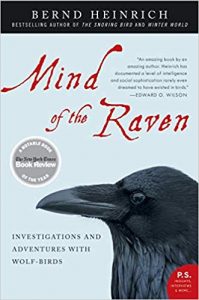
Mind of the RavenDid you enjoy Olivia’s pet raven in Wolf Dreams? Adena was originally meant to be a crow, but my husband talked me into turning her into a raven as a tribute to my Poe-loving father. Then, after writing the book, I discovered that wolves and ravens have an important relationship that likely goes back thousands of years.

In The Mind of the Raven, animal behaviorist Berndt Heinrich traveled to Yellowstone National Park just like I did but with a different goal — to figure out why wolves and ravens are so often found together in the wild. What he discovered appears to be a true symbiosis, with both species coming out ahead.

Ravens have the more obvious benefit, counting on wolves to break through tough hides so they can get to the good parts of carcasses. The birds also seem to crave the protection of a big burly wolf to make sure a passing predator won’t snap them up while they dine. No wonder ravens often show up soon after a wolf howls and hang out with wolves even while they play and rest.

On the wolf side of the coin, high-flying ravens can be handy at finding weak animals that will be easy to slaughter. In his book Brother Wolf, Jim Brandenburg tells about ravens finding a dead bear (beaucoup meat, impossible for them to access) then yelling until wolves arrived to tear the hide open. Ravens also act as sentries at carcass sites, noticing interlopers and waking wolves from their naps to chase competitors away.

“I can sneak up on a wolf,” a filmmaker told Heinrich, “but never on a raven. They are unbelievably alert.”

In fact, some scientists think that wolves and ravens consider each other family. When wolf pups are smaller than ravens, their parents don’t mind big black birds hanging around the den site and tugging on the youngsters’ tails even though they’d quickly drive any other animal away.

Perhaps that’s why I subconsciously chose a raven as Olivia’s first pack mate?

Wolves in Japan

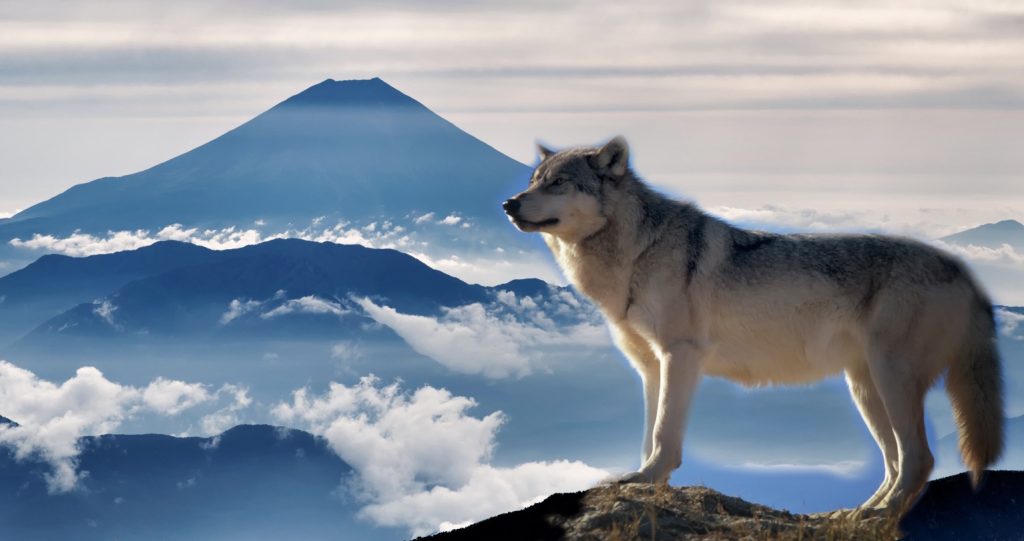
Japanese wolf

At a pull-out during my recent Yellowstone wolf tour, one of our guides ended up chatting with an expert on Japanese wolves. The story relayed was so fascinating that when I got home I had to fact check and share.

The tale begins long ago when wolves were revered in Japan. The dictates of Buddhism had led to a human diet that was largely vegetarian (with fish sometimes added to the plate). Wild animals were occasionally hunted by the lower classes, but livestock were few and far between.

In this landscape, wolves were helpers rather than hinderers. Two subspecies — the Japanese wolf (Canis lupus hodophilax) on the southern islands and the Hokkaido wolf (Canis lupus hattai) on the northern island — dined on deer and boar that ate/tore up rice and vegetable fields. No wonder wolves made their way into myth as friends rather than foes. In fact, the people of the northern island sent dogs in heat into the forest to breed with wolves in hopes of adding more lupine traits to their domesticated stock.

The tone of the story shifts in the late nineteenth century when a Japanese emperor decided to ditch a dependence on rice farming and fishing and try out American-style ranching. Wolves and livestock are a tricky combination. Soon, wolves turned into pest creatures and were exterminated.

Fast forward ahead to the modern era, when scientists began sequencing the DNA of the few stuffed specimens of Japanese and Hokkaido wolves left in museums. In the process, they discovered that the shrimpy Japanese wolf had arrived in Japan — as you might expect due to proximity — from Asia.

On the other hand, the larger Hokkaido wolves were more closely related to a North American subspecies. Scientists now believe that these leggier wolves migrated westward along the Bering land bridge about 9 or 10,000 years ago, not long after humans headed in the opposite direction onto the North American continent.

Both subspecies, unfortunately, are now very much extinct. However, you can see wolves a lot like the Hokkaido wolf along the coast of British Columbia, since scientists believe the more northern Japanese wolf subsisted just like these do on a diet of marine and terrestrial prey at the edge of the water. Not so different from the ancient Japanese people who once called these wolves friends.

A highly recommended Yellowstone wolf watching tour

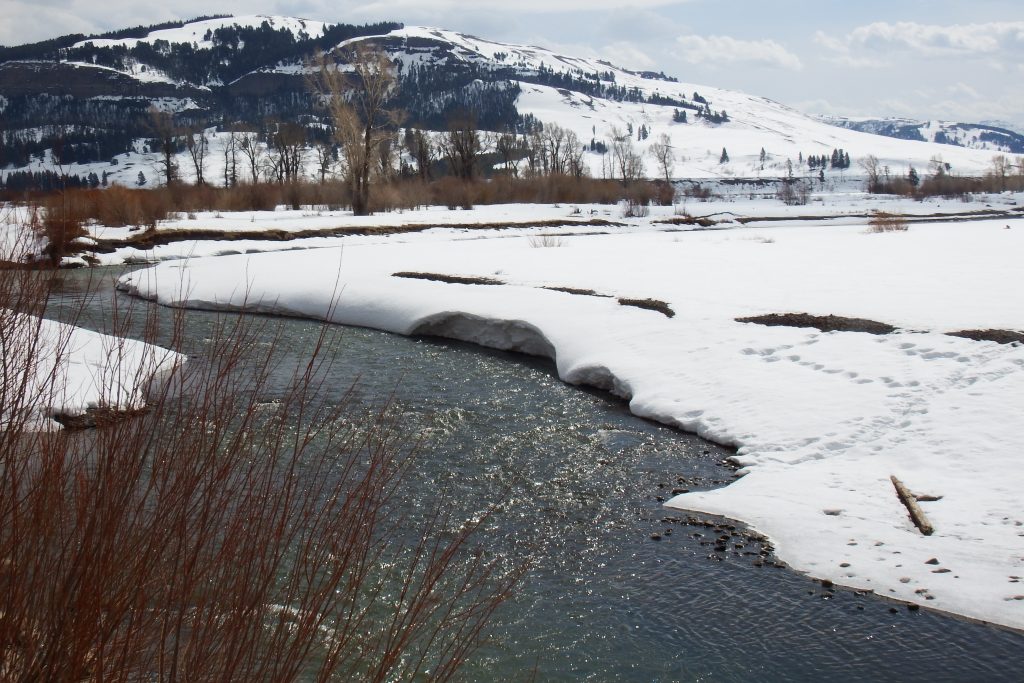
Lamar Valley

If you’ve been reading along with me all week, you probably have a question — what tour did I sign up for and do I recommend it?

Short answers: Yellowstone Wolf Tracker. And, yes, all of those five-star reviews on Trip Advisor are very much deserved.

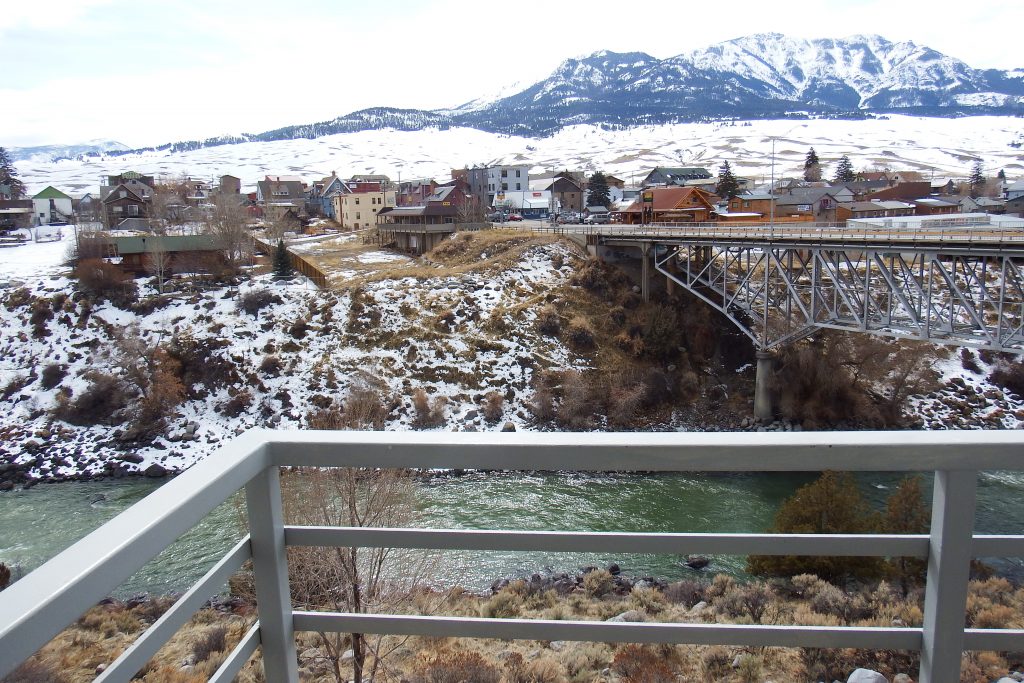
View from balcony of Absaroka lodge

For five days, I completely lost track of the outside world. I reveled in stunning scenery…

Ecotour

…enjoyed like-minded company…

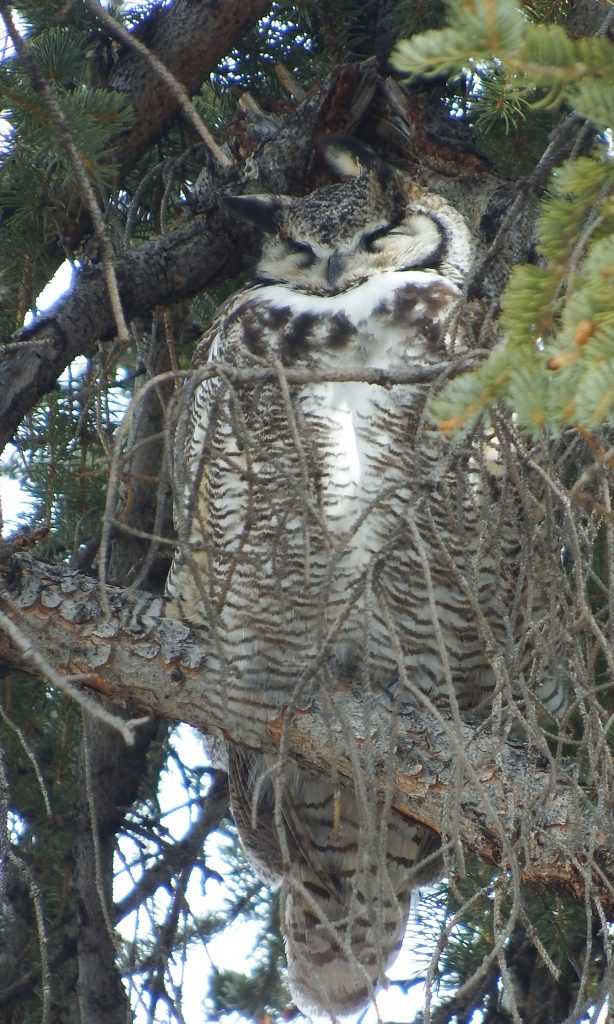
Sleeping Great Horned Owl

…followed knowledgeable, personable guides to track down astonishing wildlife-viewing (and –photographing) opportunities…

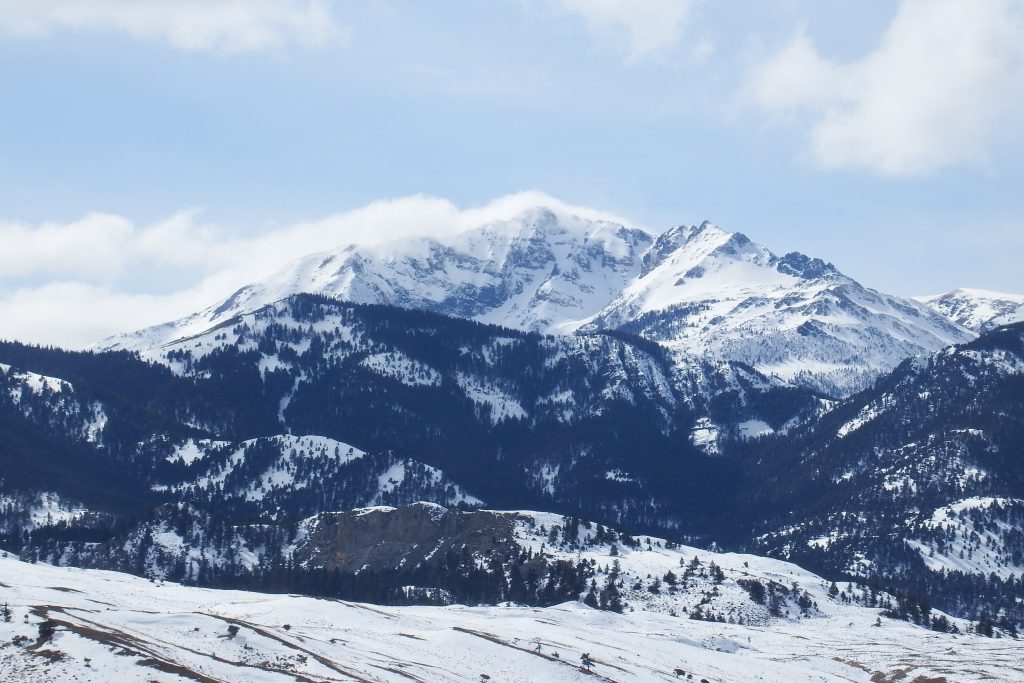
Yellowstone Mountain

…ate delectable food…

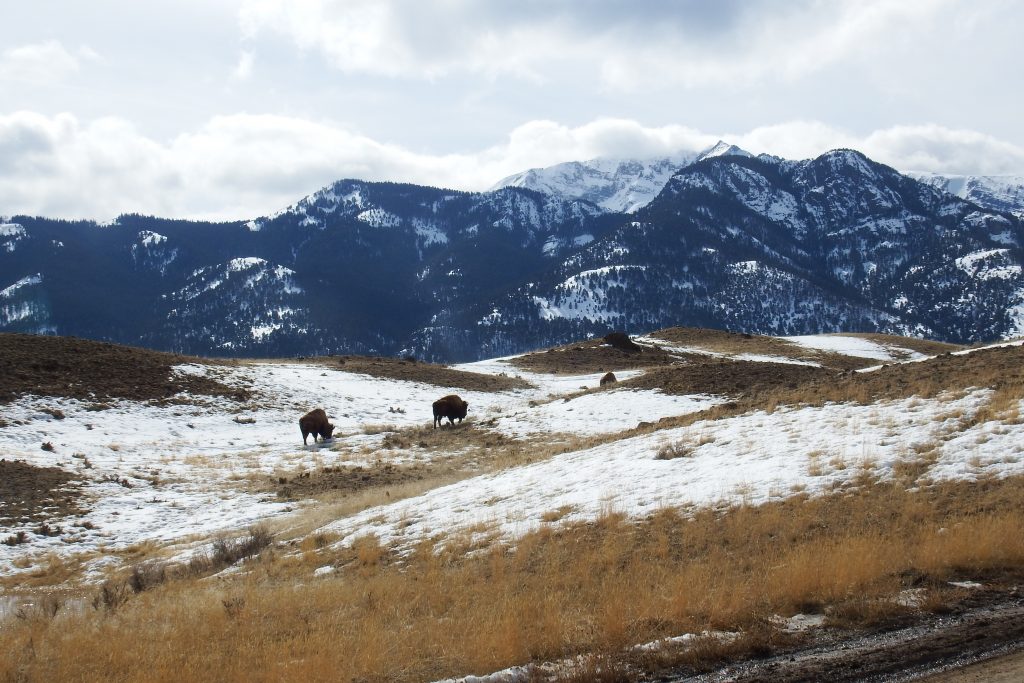
Bison and mountains

…and enjoyed bonus talks by local experts after dinner.

To cut a long story short — due to a combination of legal protection, radio collars, and open landscape,Yellowstone is one of the few places in the world where you can dependably watch wolves in the wild. And the leaders of Yellowstone Wolf Tracker are immensely knowledgeable experts with decades of experience, able to not only guide you to the wolves but also fill in the blanks with endless information and stories about the animals you see.

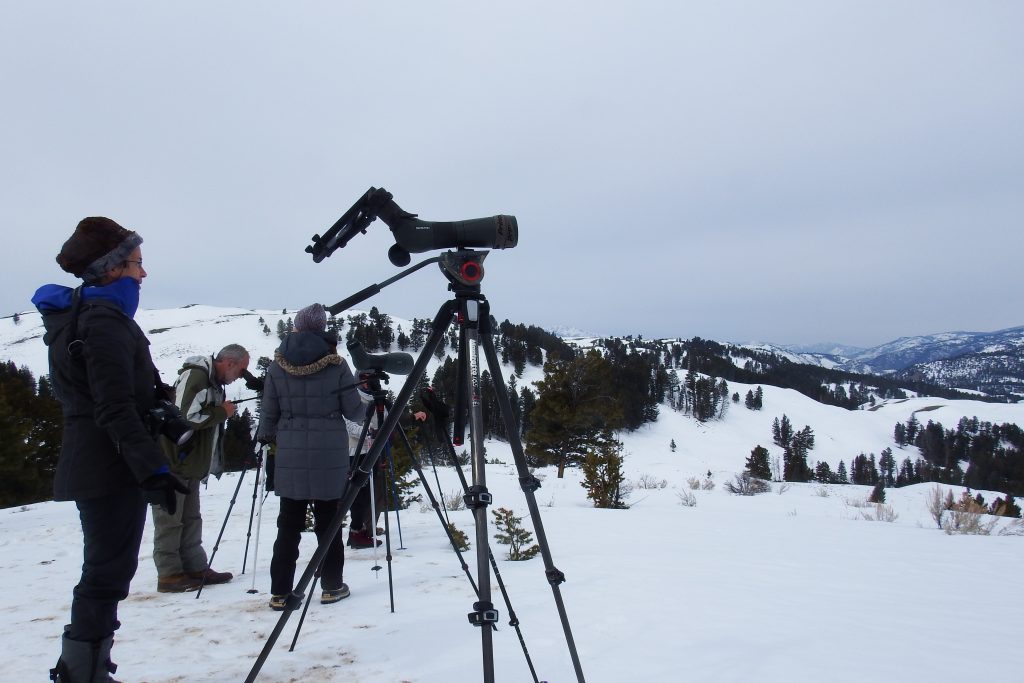
Wolf watching through a scope

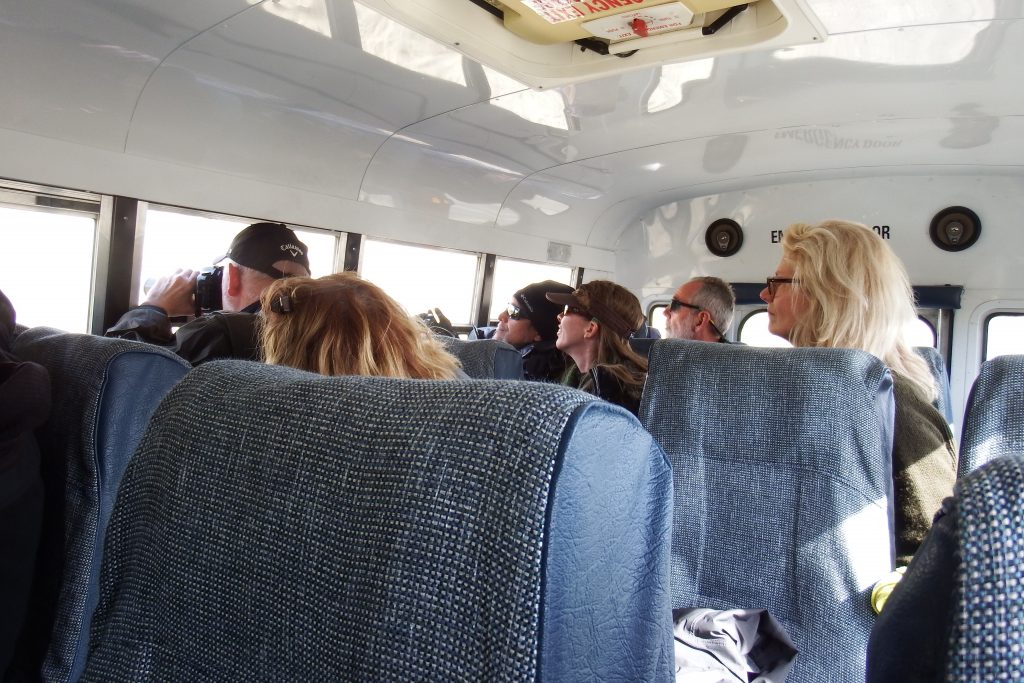
There are some caveats, however. I doubt this trip would appeal to children or to the impatient — there are long periods of standing in the cold, waiting and hoping. And when you do finally see wolves, they are almost always very far away, visible only via scope.

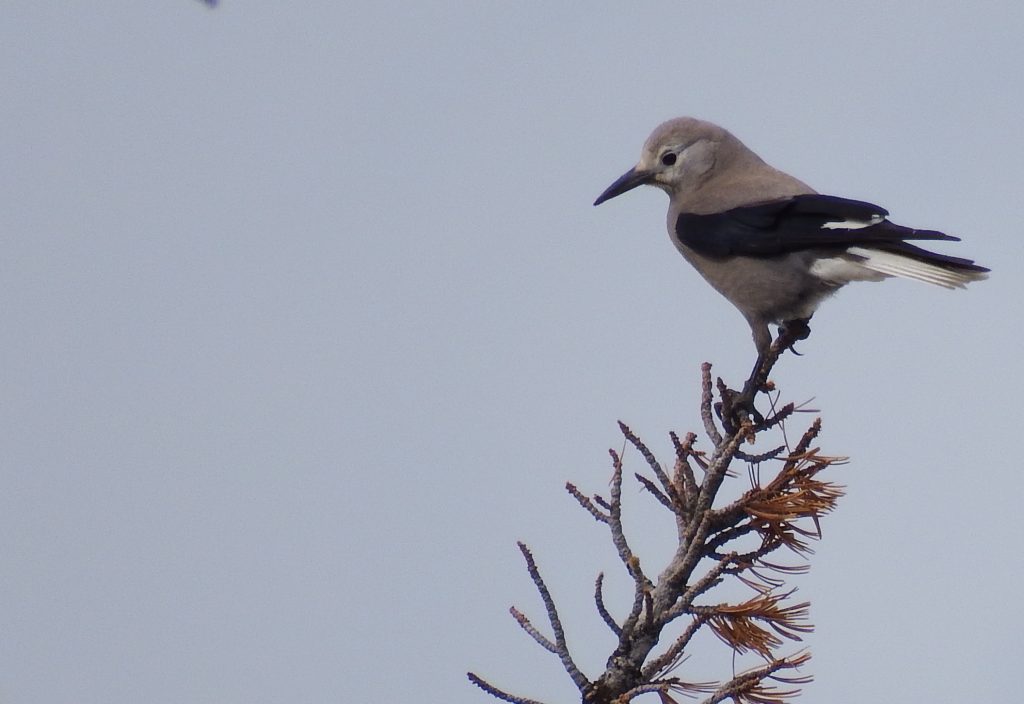
Clark's Nutcracker

(A fact that is very much made up for by the obliging nature of other wildlife, like this Clark’s Nutcracker.)

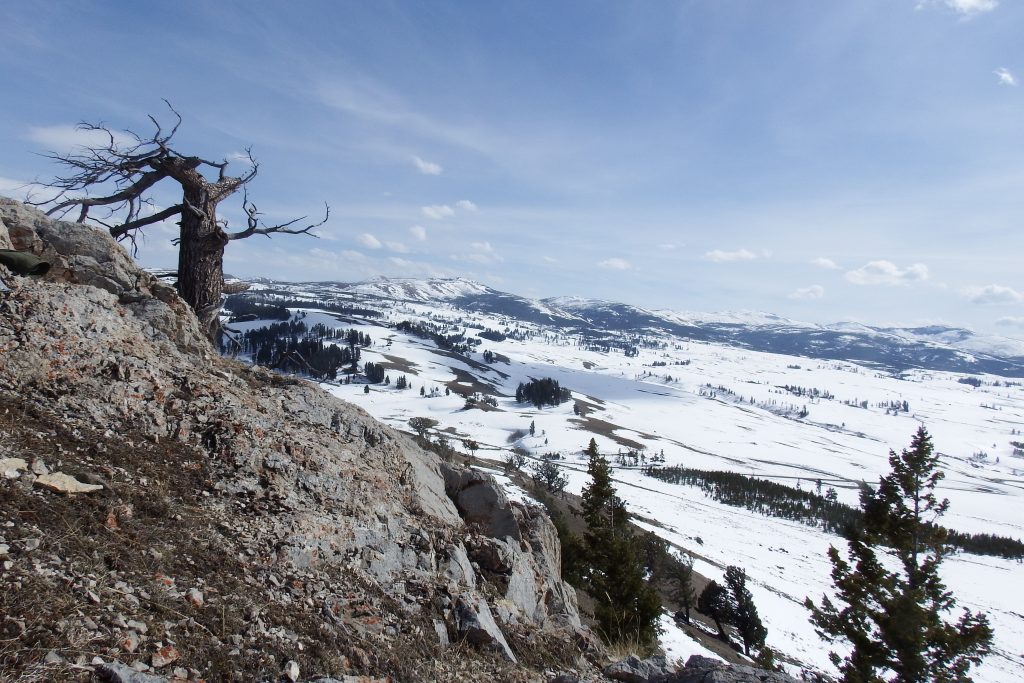
View from North Butte

The days were also very long with almost no alone time, which pushed my introvert nature to the limit.

Bull elk without his antlers

(Of course, that was my own fault. I could have skipped various optional activities…but when it came right down to it I preferred pushing my limits rather than losing a moment of this amazing tour.)

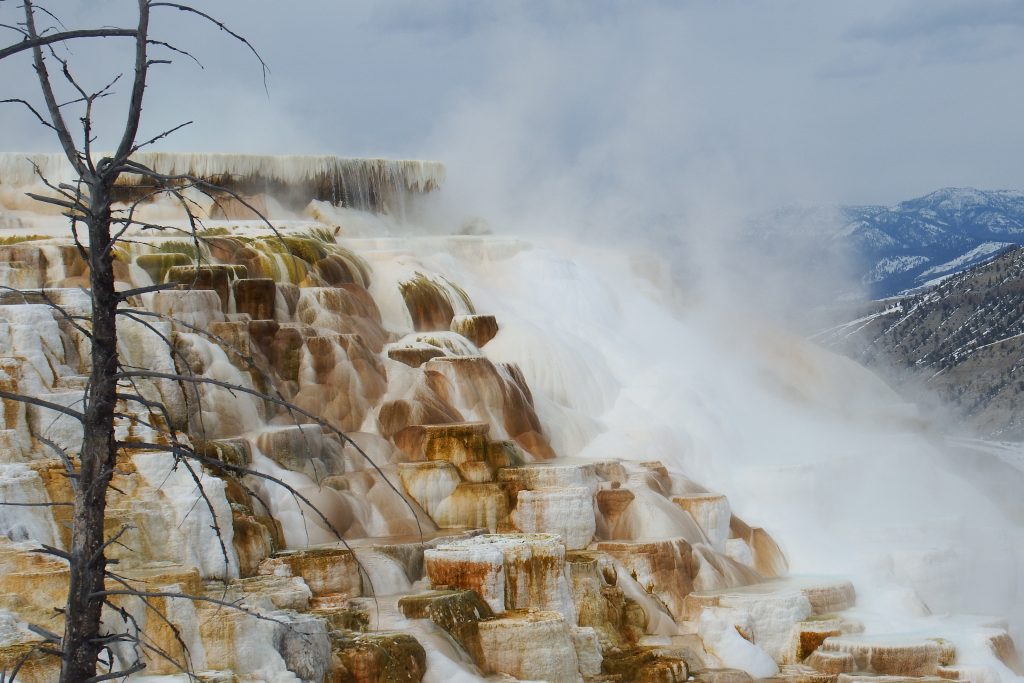
Mammoth hot springs

In the end, the only real negative is the price tag. Otherwise, I’d be signing up for every wolf watch Nathan and company leads.

If you want to be involved but can’t drop a couple of grand on the full adventure, there are other ways to engage your imagination. I read a bunch of books on Yellowstone wolves leading up to my trip, and I thoroughly recommend the following:

  • Decade of the Wolf — This is an easy-to-read, riveting summary of the first ten years of Yellowstone wolves, from capture in Canada to spread throughout the park. The profiles of individual wolves made me feel like I really knew them on a personal level and the whole thing was full of fascinating tidbits and evocative passages.
  • Yellowstone Wolves in the Wild — The photos in this book are astonishing, and the behavioral information was some of the best I’ve found.
  • American Wolf — I haven’t read this one yet, but several of the tour participants loved it. I gather this is a deep look into the life of one very popular wolf. (I currently have it on hold at my local library.)

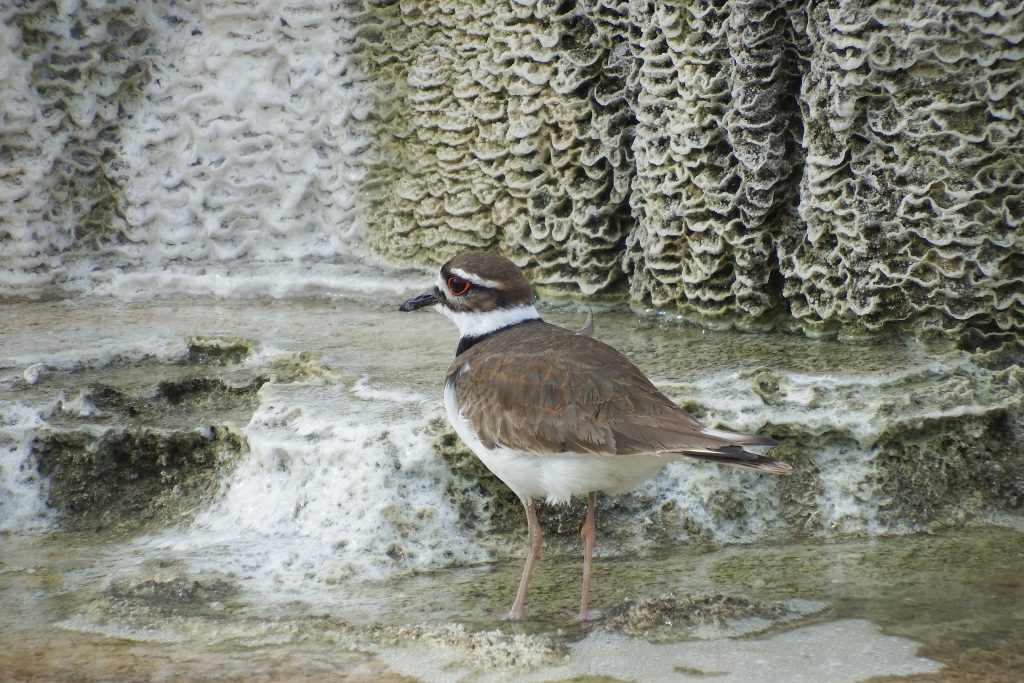
Killdeer at a hot springs

Alternatively, if you’d like to help ensure the survival of these magnificent creatures, a couple of non-profits might be right up your alley:

  • Yellowstone Forever is responsible for all of the amazing science that goes into collaring, tracking, and studying the park’s wolves. With their help, two decades of Yellowstone wolf watching has taught us more about the species’ behavior that centuries of previous studies managed to ferret out.
  • Bear Creek Council is a grassroots nonprofit that takes engagement to another level. This group deals with thornier issues that transcend boundaries, like the fact that wolves who set foot out of Yellowstone often fall to hunters’ bullets.

And there you have it — a life-changing week in a nutshell for your reading enjoyment. I hope you had fun wolf watching along with me!

Have something you want to share? Click the facebook link below to comment:

The power of pack

Coyote against white snow

A lone wolf, a wolf family, three coyotes, and a grizzly bear taught me an important lesson on the power of pack last week. Perhaps you’d like to share in the excitement?
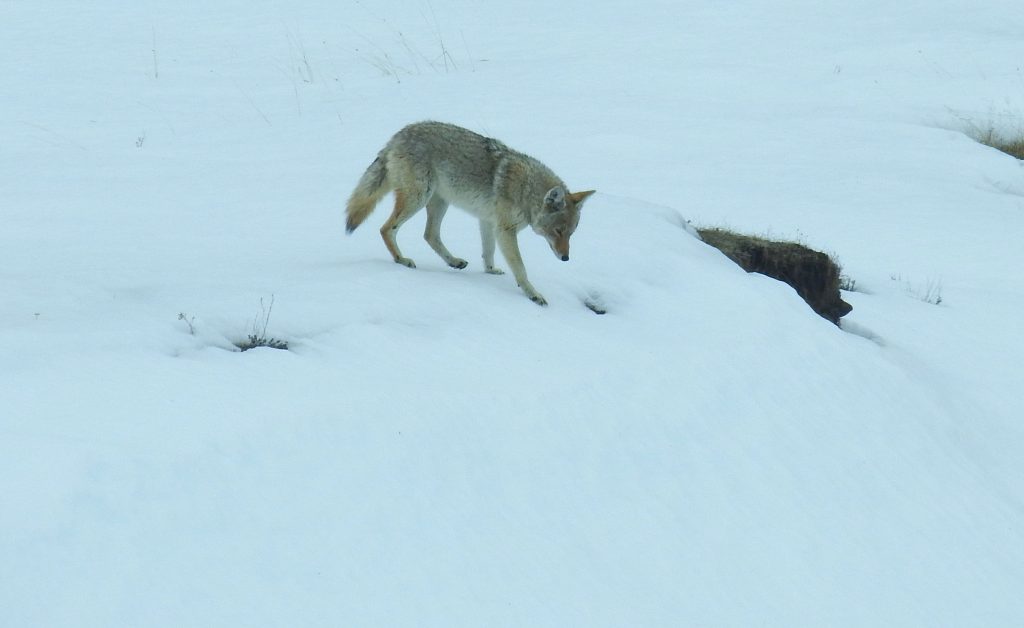
Coyote in the snow

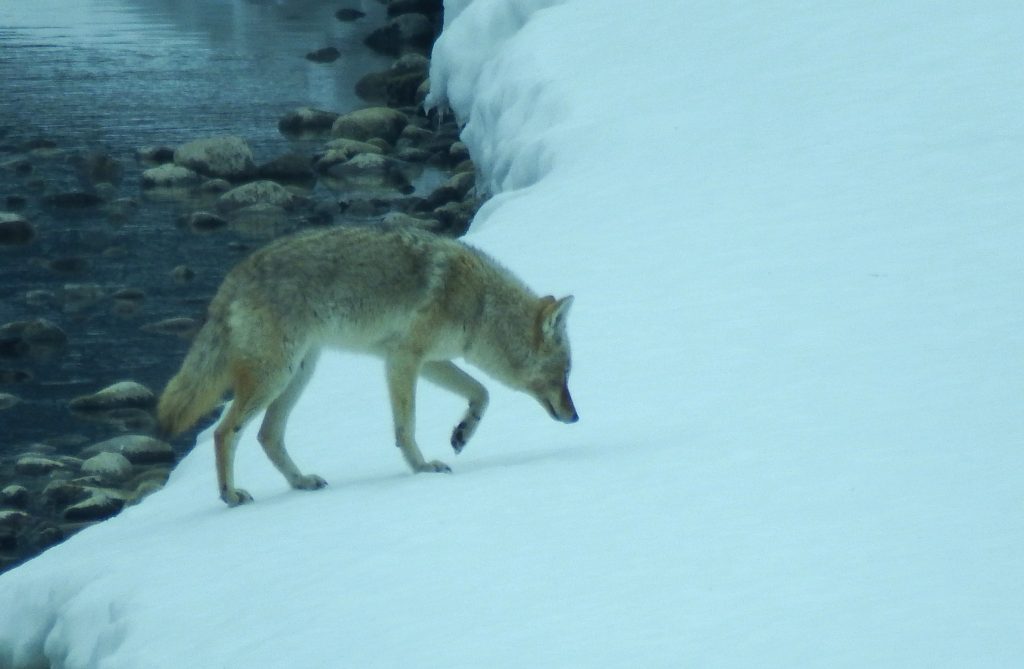
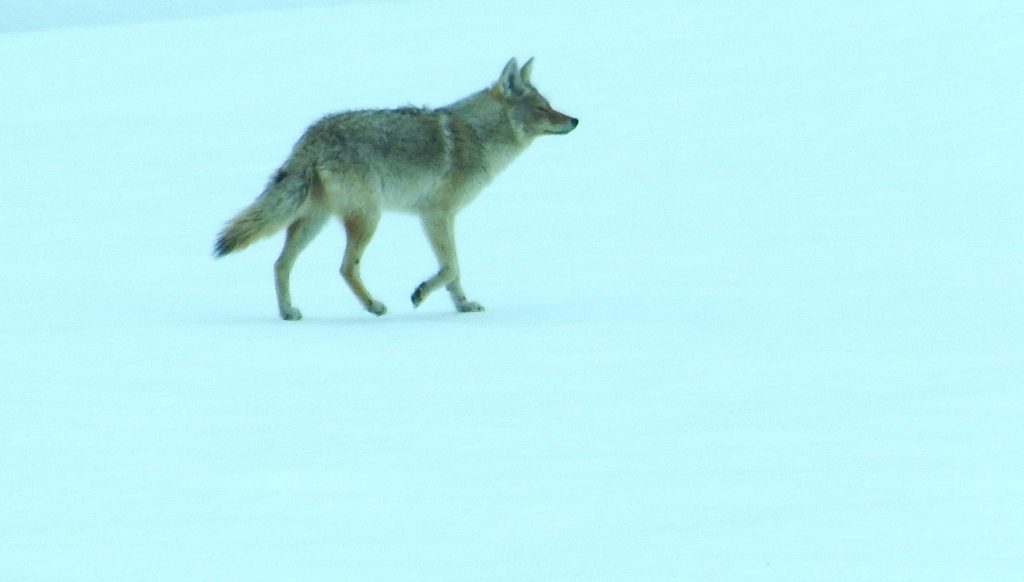
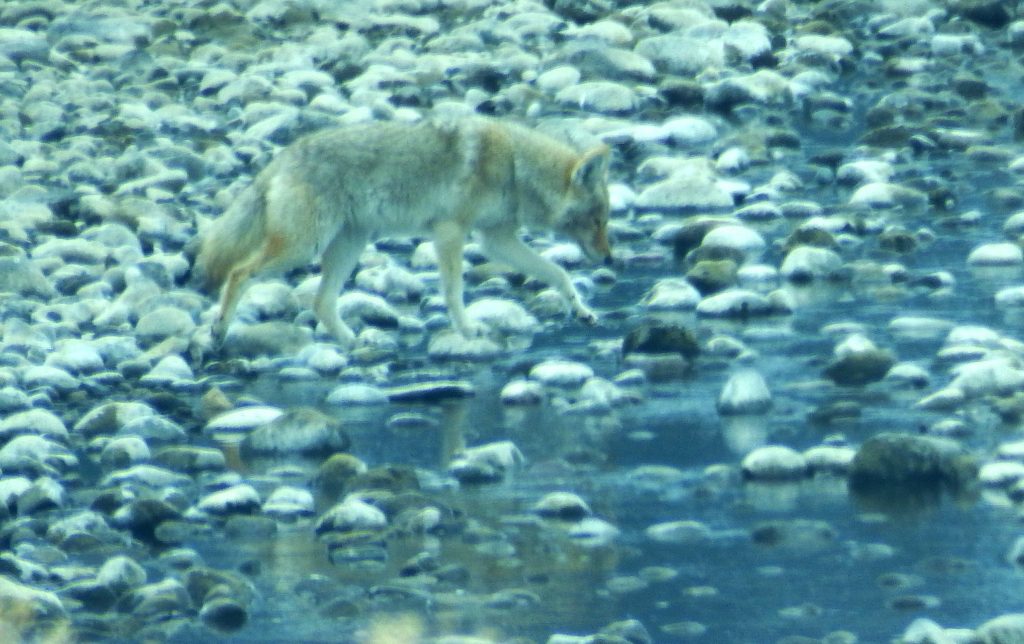
Before I continue, I should warn you that all of the closeup photos in this post are from a different place and time. I was so riveted by the action (and the characters were so far away) that I couldn’t take my eye off the scope long enough to pull out the camera. So, please consider the photos here more an imagination boost than anything else.
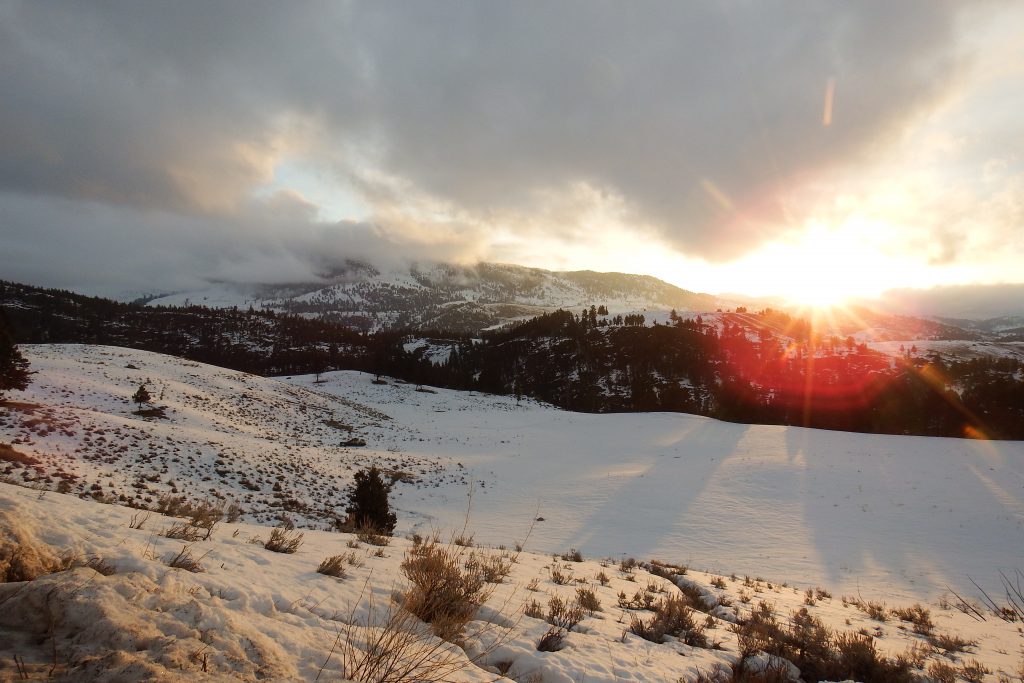
Winter dawn in Yellowstone

That caveat aside, my story starts at dawn in the North Range of Yellowstone. A bit to the right of the sun in the photo above, the Junction Butte pack was hanging out around a bull elk carcass that they’d taken during the night.
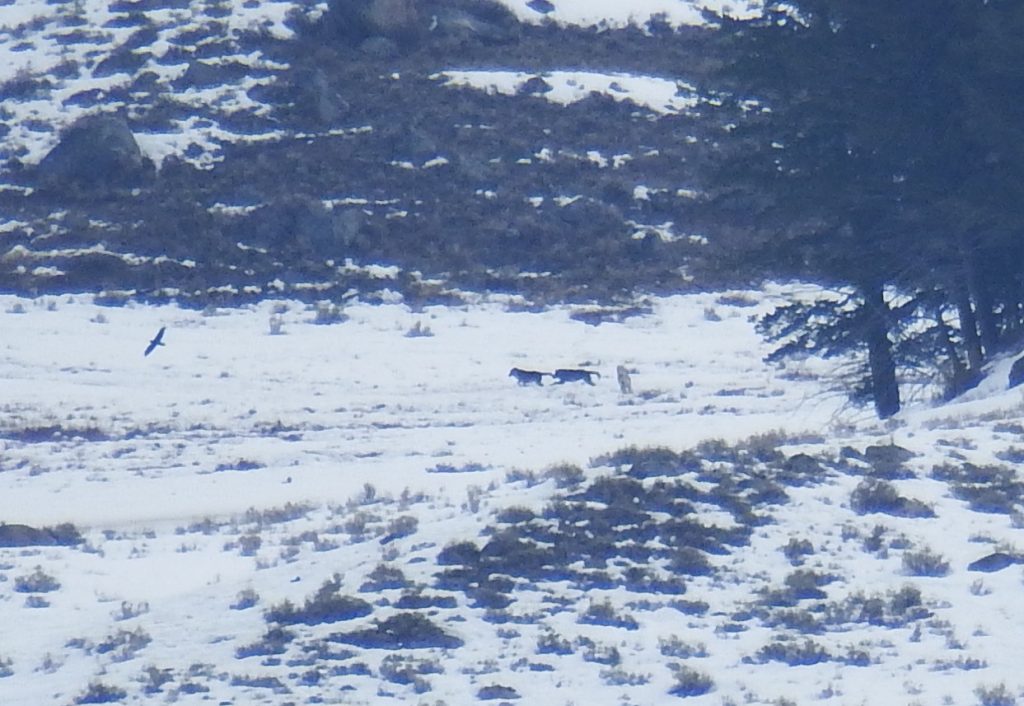
Playing wolf pups

The eleven-month-old pups were playing. The adults were sleeping.
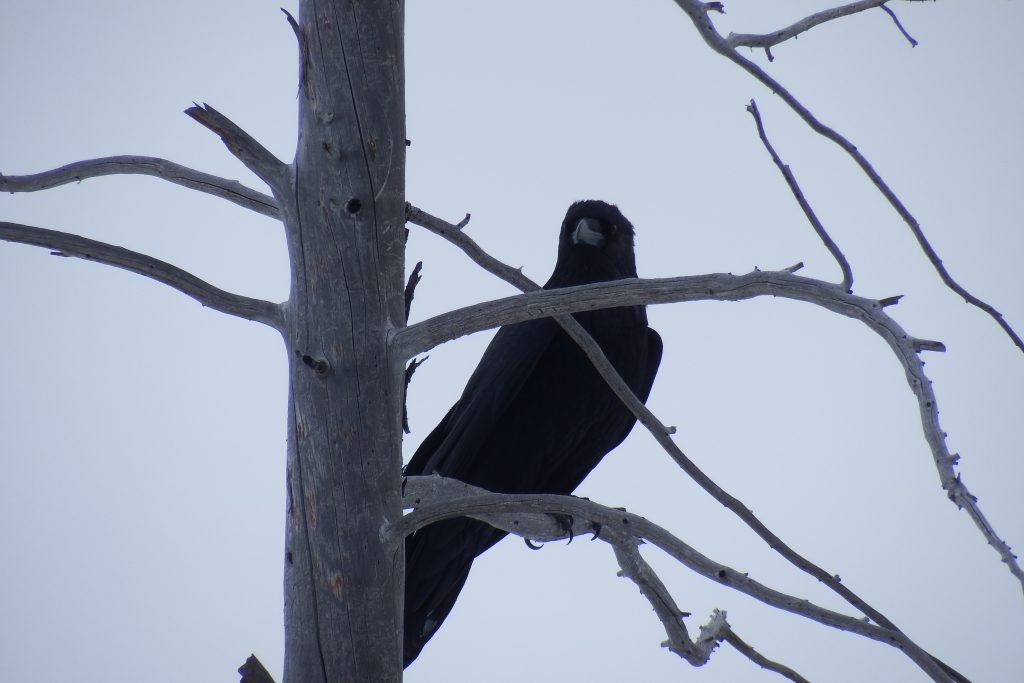
Raven on a dead tree

Ravens were sneaking in to steal bites. And, at various spots along the road, wolf watchers had set up their scopes to watch the action unfold.
Coyote smelling the ground

There wasn’t much action though, once you got over the cuteness of the pup play. So, when we heard coyotes yipping perhaps halfway between us and the kill site, many folks moved our scopes over to Yancey’s Hole to check out the wolves’ smaller relatives.

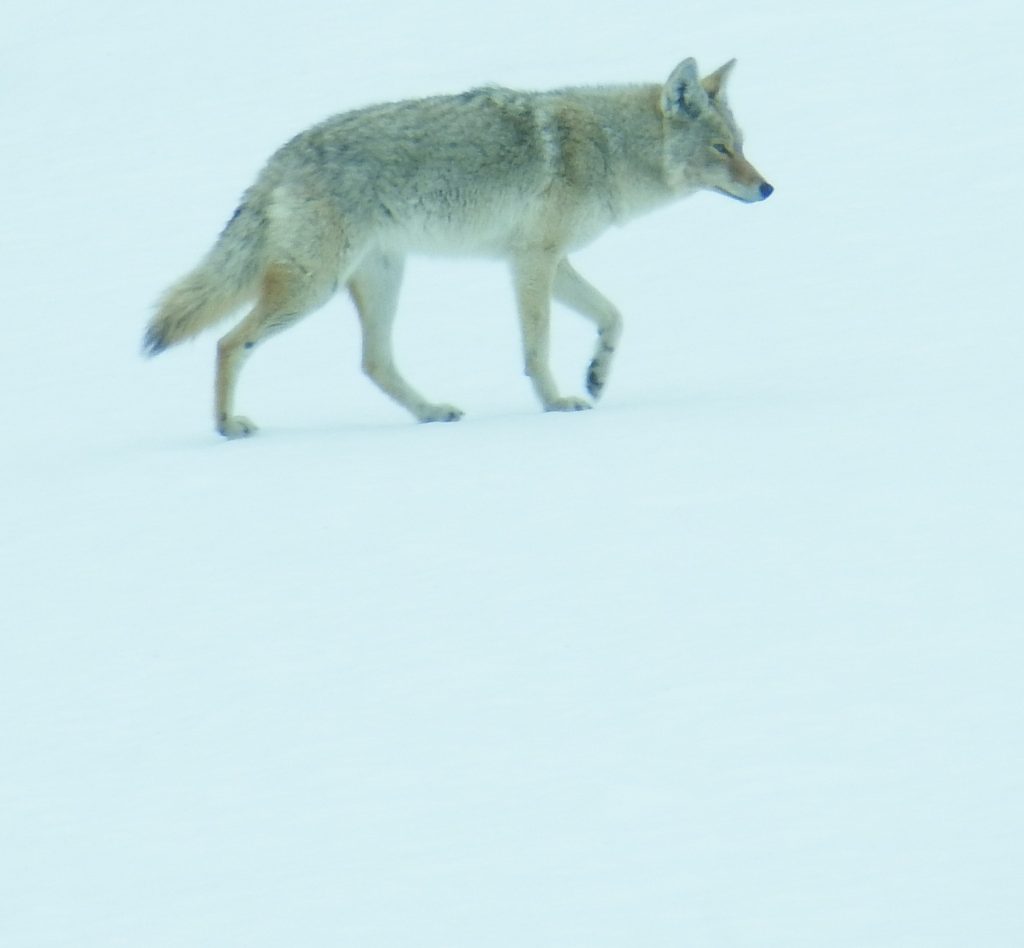
Coyotes, as you may or may not know, have a social structure a bit like that of wolves…but different. Weighing in at a third the mass of wolves, coyotes go for small prey and generally hunt solo. They do defend territories from other coyotes, and they do bed down together once hunting time is done. But even the full pack is usually just a handful of animals — a mated pair plus maybe a few youngsters from last year.
Alert coyote

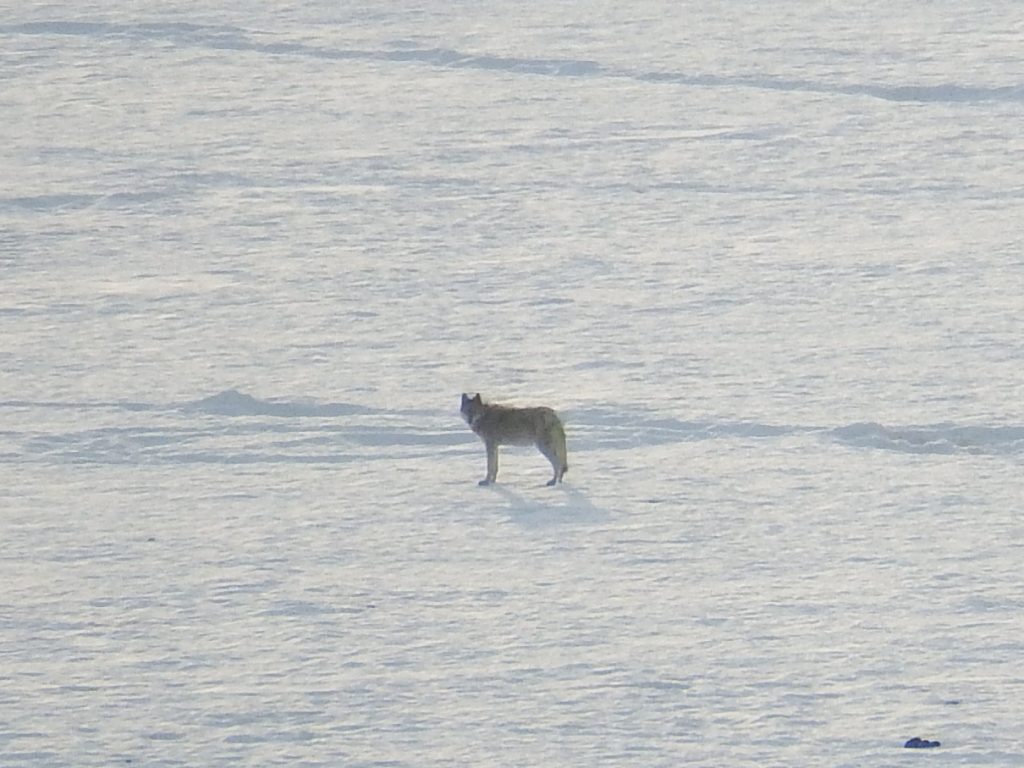
In this case, there were three coyotes on the frozen ice…and all of them were looking to the left. Smart guides know that when groups of animals all peer in the same direction, you should look that way too. Sure enough, off to the left was:
Wolf on the ice

…a lone wolf! (Yes, this is my very best wolf photo of the entire trip.)

The books tell me that a wolf is always the winner in a coyote-wolf interaction. That’s why, soon after wolf reintroduction to Yellowstone, coyote numbers declined dramatically (and fox numbers actually went up since coyotes, in turn, kill their own smaller relation).

What the books don’t say is that a pack trumps a lone animal any day of the week.
Coyote by a stream

In this case, the wolf initially looked like it might be able to wander through coyote territory unscathed. But it was three against one, and before we knew it the coyotes were driving their larger relative up off the ice and into the snow.
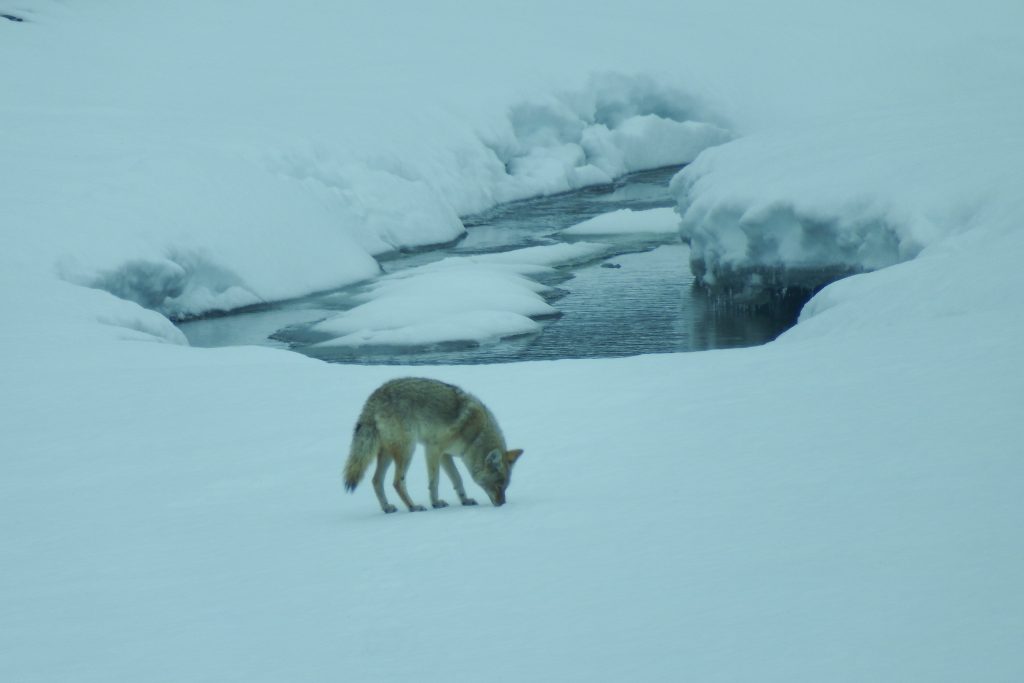
Coyote beside icy pond

The story became more poignant when our guide clued us in to the lone wolf’s likely identity. Leo Leckie knows each wolf in the park by number and ancestry and can tell you in great detail about the soap-opera drama of mating, fighting, and hunting in which the packs engage.

In this case, Leo had two guesses about the uncollared lone wolf’s identity. The most likely scenario, he told us, is that this was a youngster who used to be part of the Crevice Creek Pack before said grouping splintered and failed. It all began when yet another pack lost their alpha male to a hunter outside the park boundaries, leaving the females without their patriarch. Their hunt for a solution was as bloody as the initial problem — they drove the alpha female out of the Crevice Lake Pack and stole her males, leaving this pup alone in the cold.

Life is tough for a lone wolf, as I soon discovered. But he was lucky to run into coyotes — less bloodthirsty — rather into than another wolf. In this case, the smaller canines just got the wolf’s attention, then they escorted him out of their territory in one long line running along the top of a hill. First came a coyote, then the wolf in the middle, then two more coyotes bringing up the rear.

They were running so fast I could barely keep up through my scope. Then, a shout from the side of the parking area:

“Grizzly bear!”
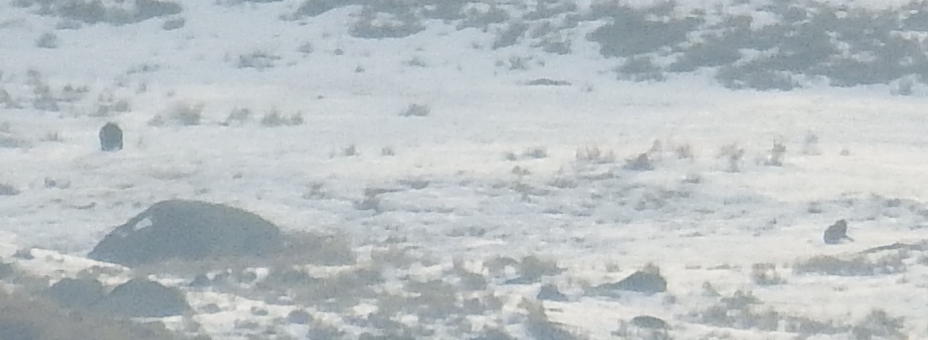
Grizzly bear and wolf

As a unit, every one of the wolf watchers whipped our optics back up to the more distant carcass site, leaving that lone pup to escape on his own. Because grizzlies were just coming out of hibernation, so seeing one at that time of year was considerably rarer than a wolf sighting. But sure enough, there the bear was, lumbering toward the site of the bull-elk kill.

(In the sad photo above, the grizzly is on the far left and a wolf is on the far right for scale.)

Now, once again, let me start with book learning. Grizzly bears are tremendous compared to a wolf, so it’s no surprise that they steal wolf kills left and right. In fact, some naturalists have reported that grizzlies follow the scent of wolves, looking for a dinner to steal rather than taking down their own prey. I fully expected the Junction Butte pack to lose their dinner and have to move on.
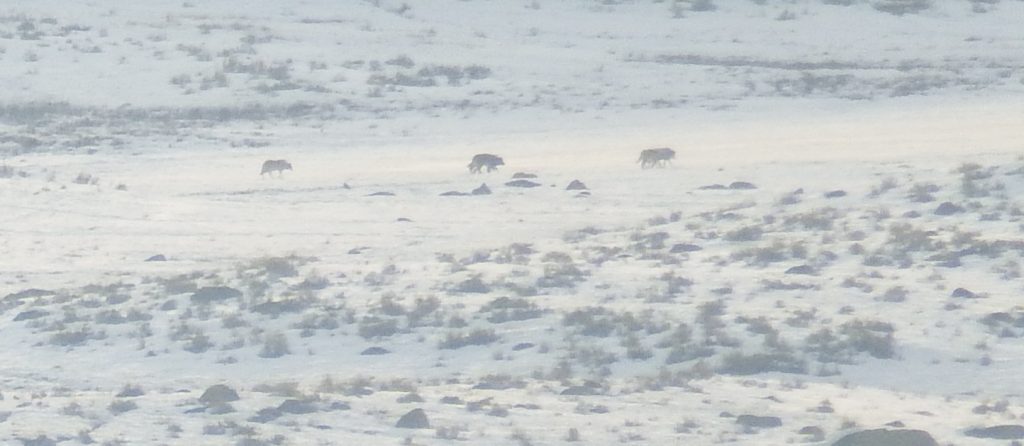
Wolf pack at carcass

But this post, as you may recall, is about the power of the pack. Five or six wolves were on that bear by the time I got my scope refocused. They mobbed the larger animal, jumping and biting…and within seconds it was the grizzly rather than the wolves who headed away.

And, okay, so the grizzly didn’t run scared like the lone pup had in the face of coyotes. Instead, the bear ambled, a bit like my cat when I shoo him off the counter. “I didn’t want that carcass anyway,” I could almost hear the grizzly say.

But the wolves did want the carcass…and they kept it. And that, many scientists suspect, is why wolves live in packs.

What do you think? I hope you’ll share your thoughts via facebook:
A kitsune teaches me to hunt voles

Red fox in the wind

I have 700 photos and 20 pages of notes to pore over, so I almost didn’t know where to start. How about a snack to tide you over while I wait for dawn?

Listening fox

My group was treated to extended viewings of three species of “dogs” during our three full days touring Yellowstone. And all three shared one behavior — mousing.

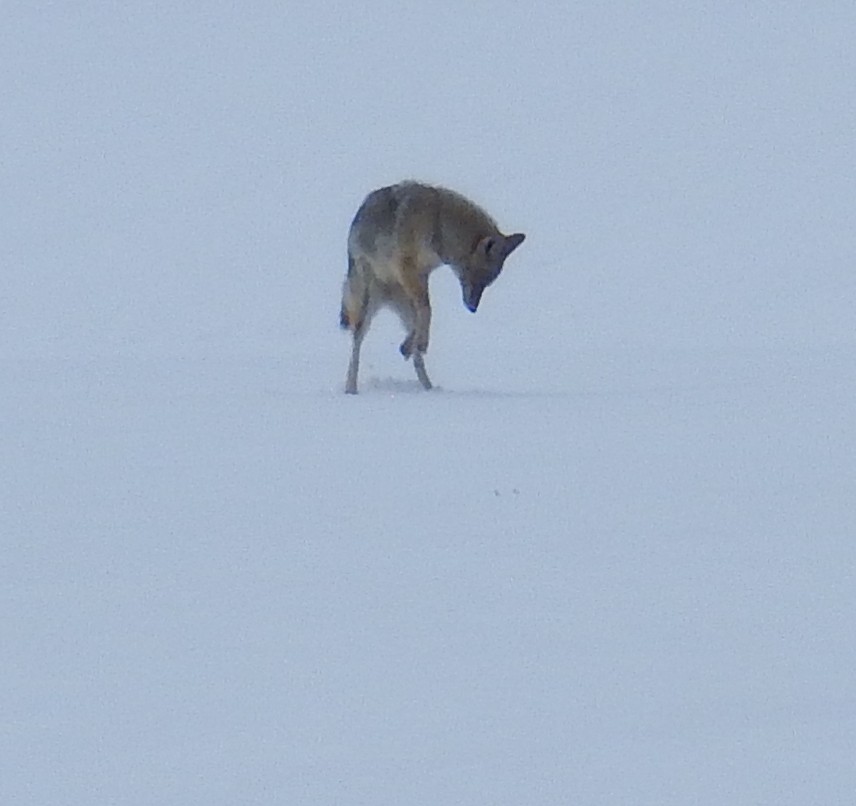
Mousing coyote

Wolves were playful about it, with only pups taking part (and often doing so together). The coyote we watched (shown here) was intent and focused. But the fox was pure elegance…so I guess I should let Kira teach us how to take out voles.

Laughing fox

Kira: The first thing I do is find a nice, broad expanse of snow beside a road. In fur form, I’m absolutely stunning and bound to stop traffic. Gotta go with your strengths.

A fox braced against the wind

Me: Okay, Kira. That’s helpful advice. But I think what folks what to hear about is how you figure out the location of a mouse-sized rodent a foot or more beneath the surface of crusty snow while the wind is blowing and your nostril hairs are freezing together.


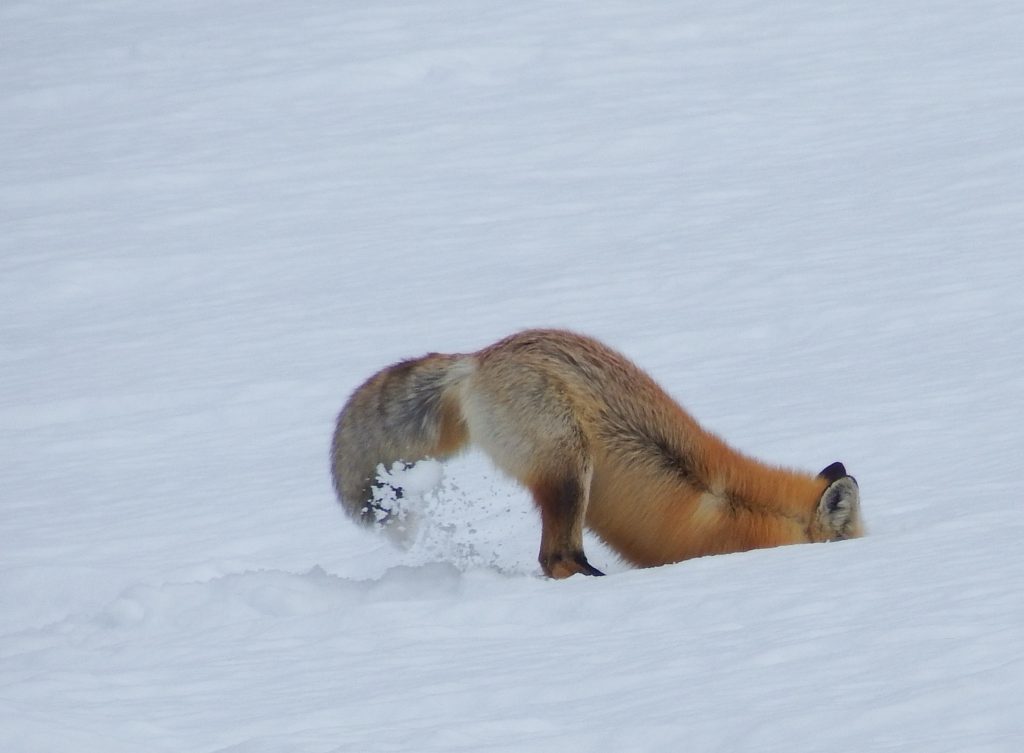
Digging fox

Me: Do you dig?

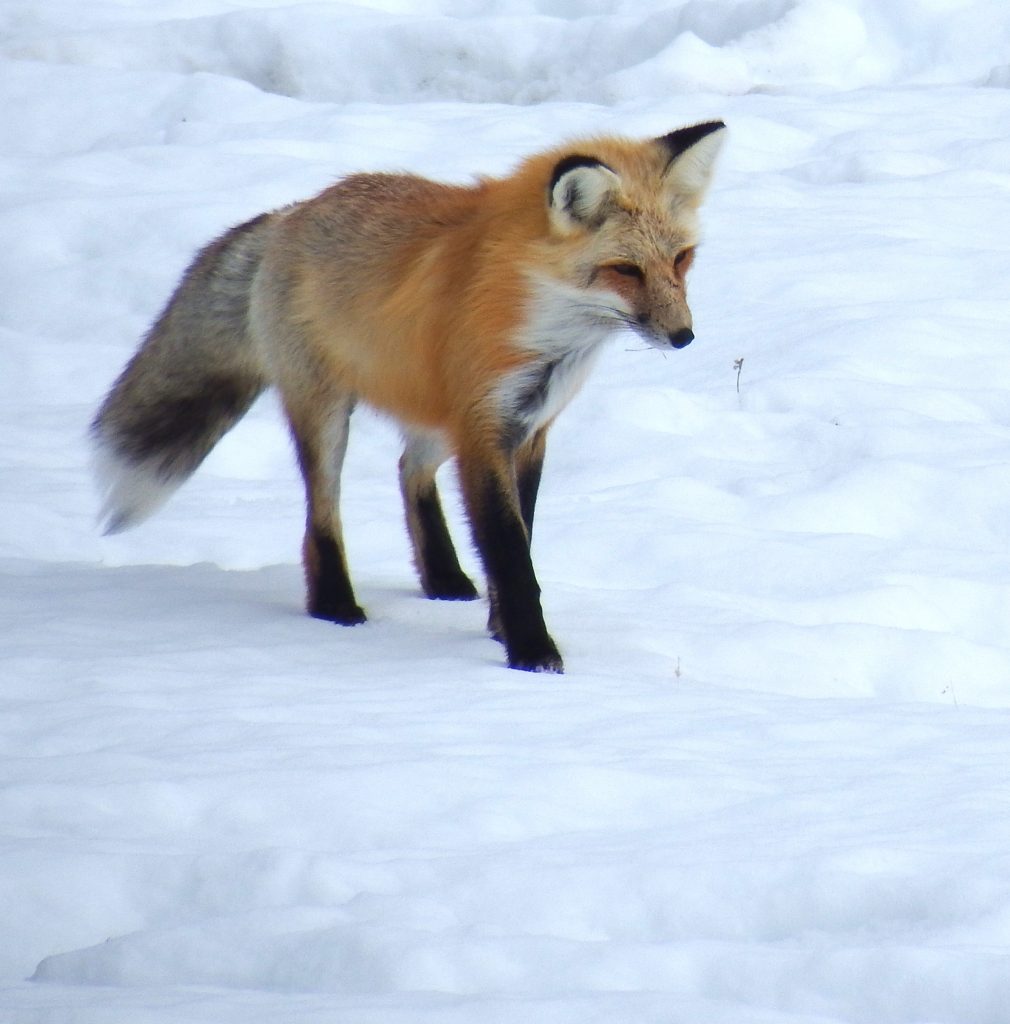
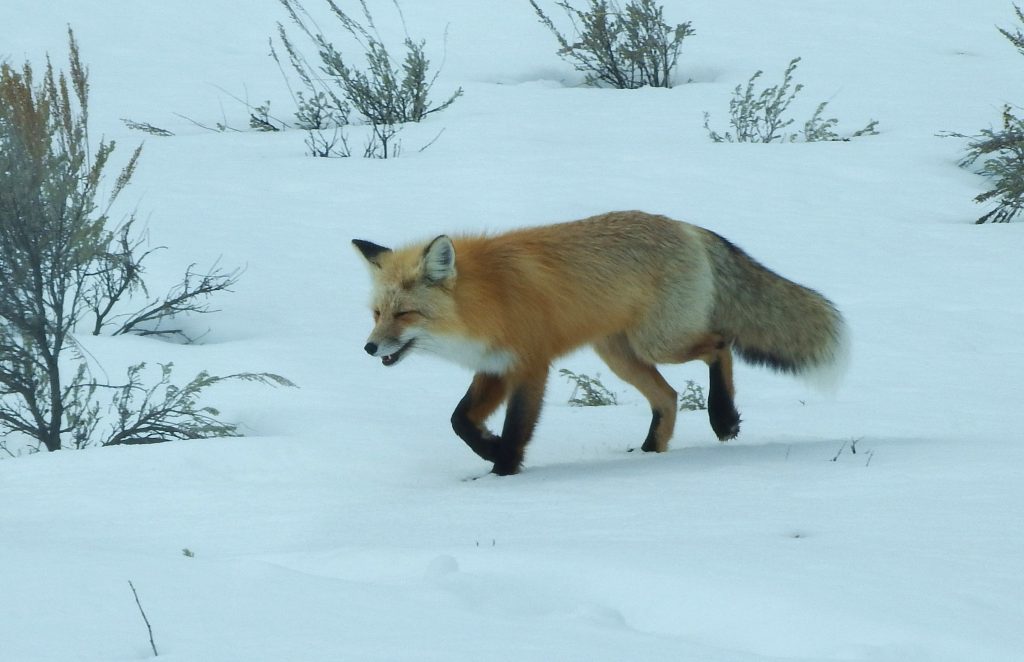
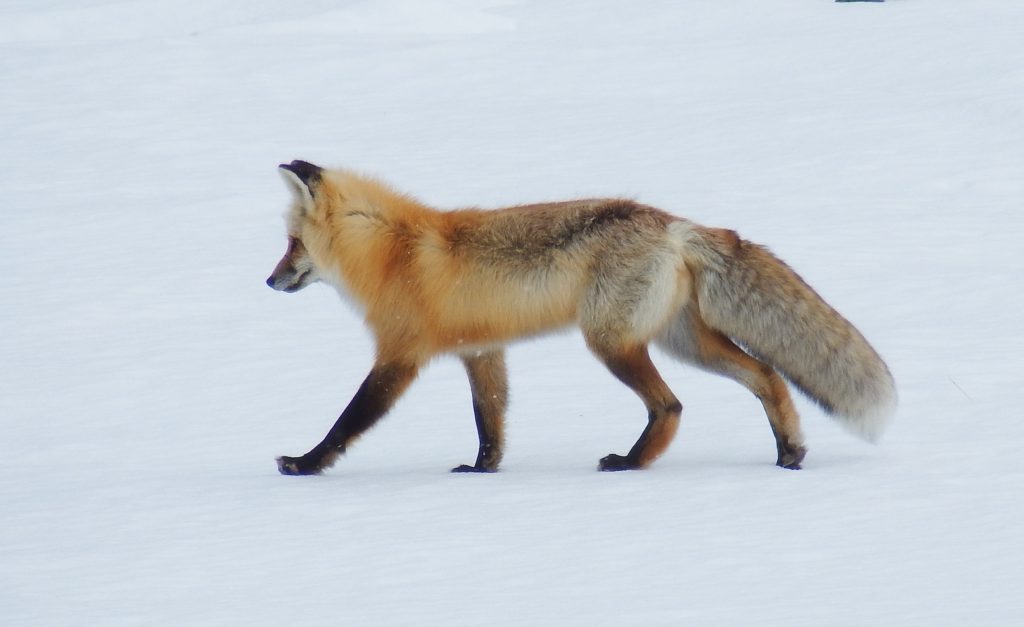
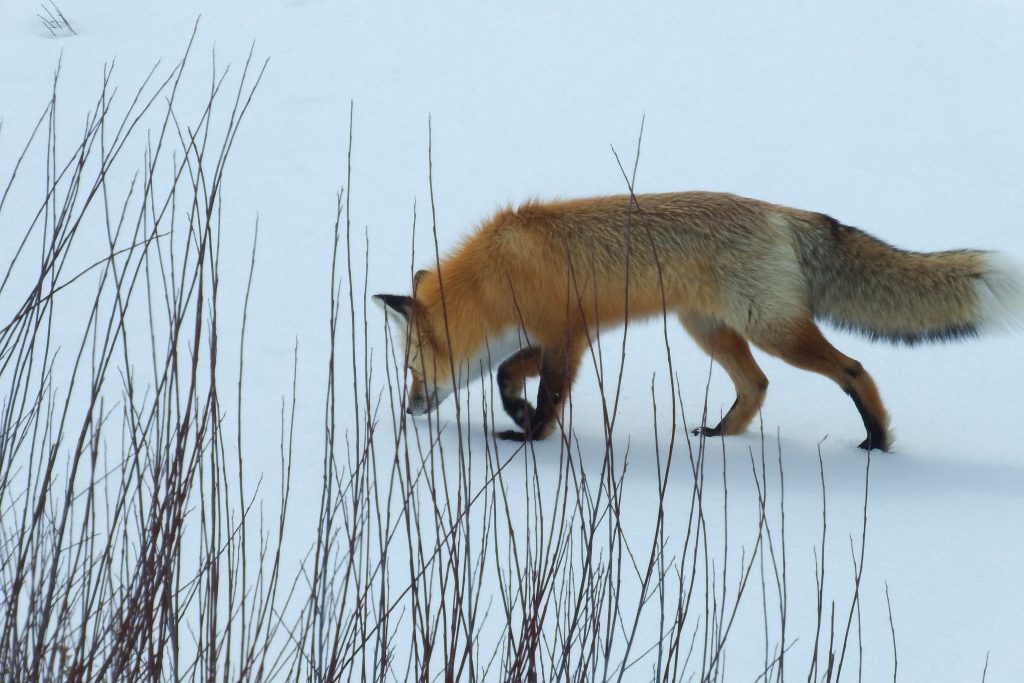
Walking fox

Kira: If you really want to make it hard for yourself, you can dig. But that’s pretty boring. I like to use my ears and my pounce.

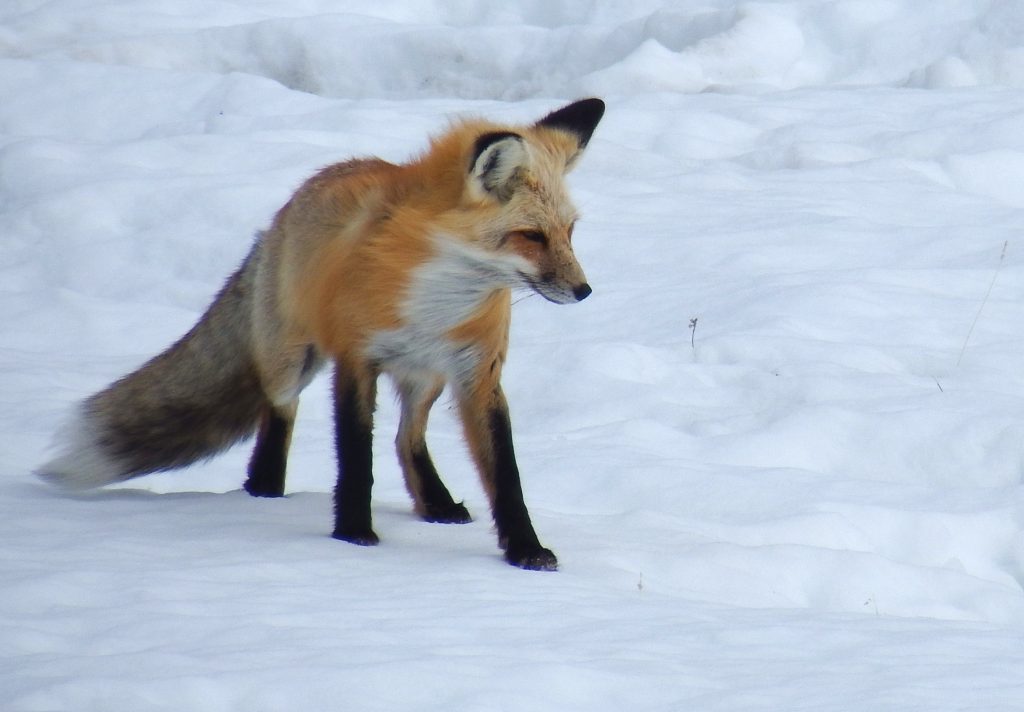
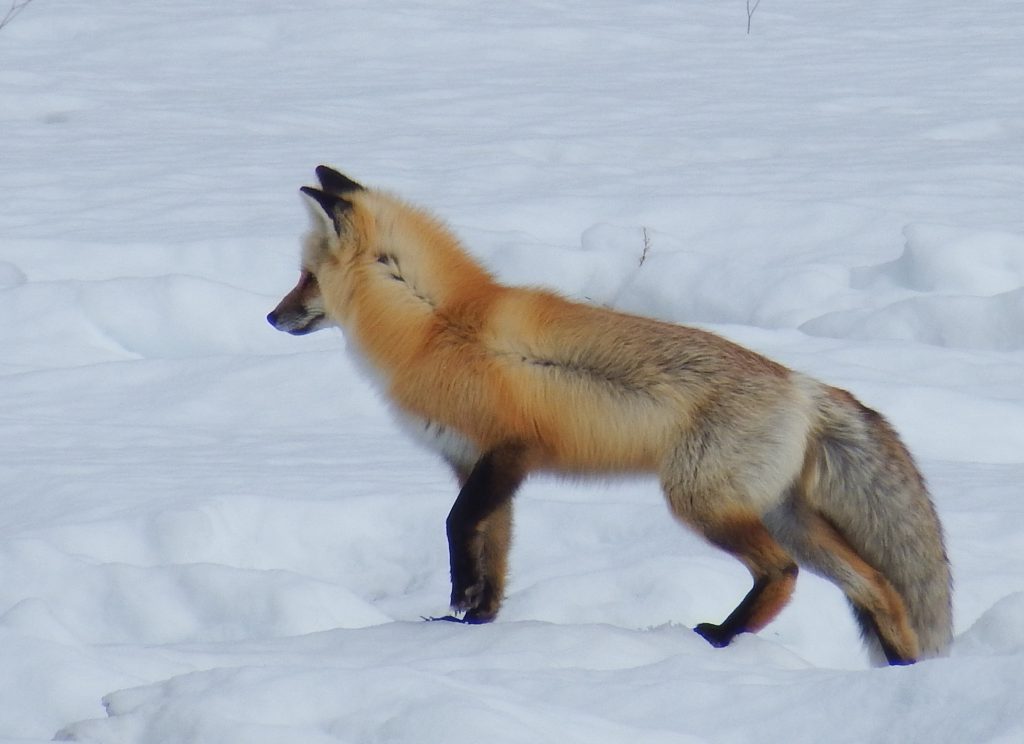
Listening fox

Kira: Fox ears are pretty awesome things. All you have to do is walk around on the crusty surface, listening, and soon you hear that first little scratch.

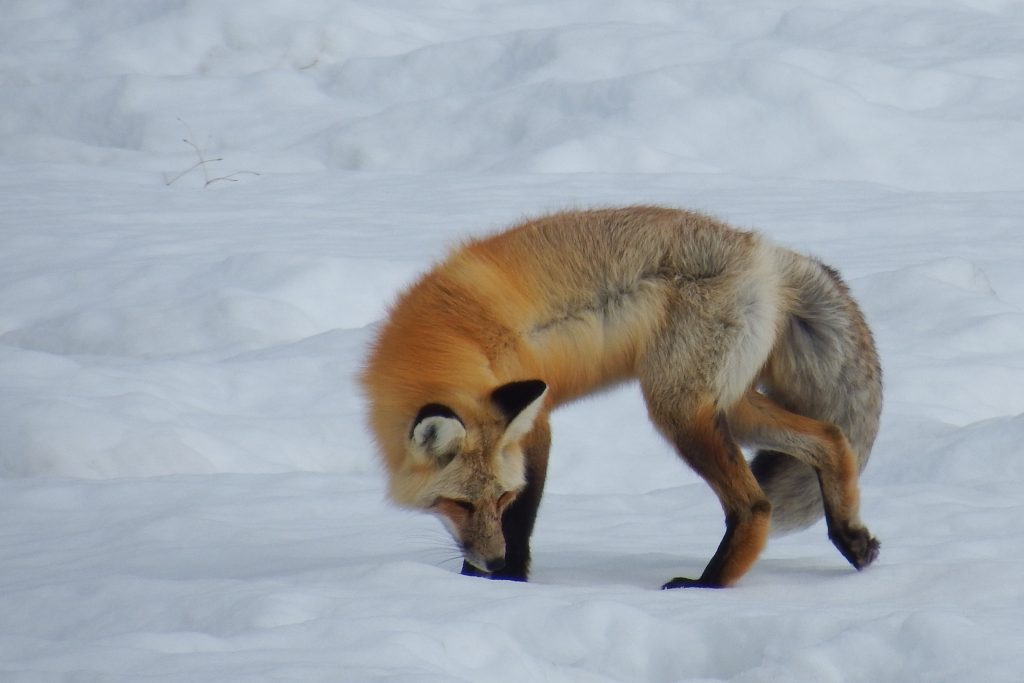
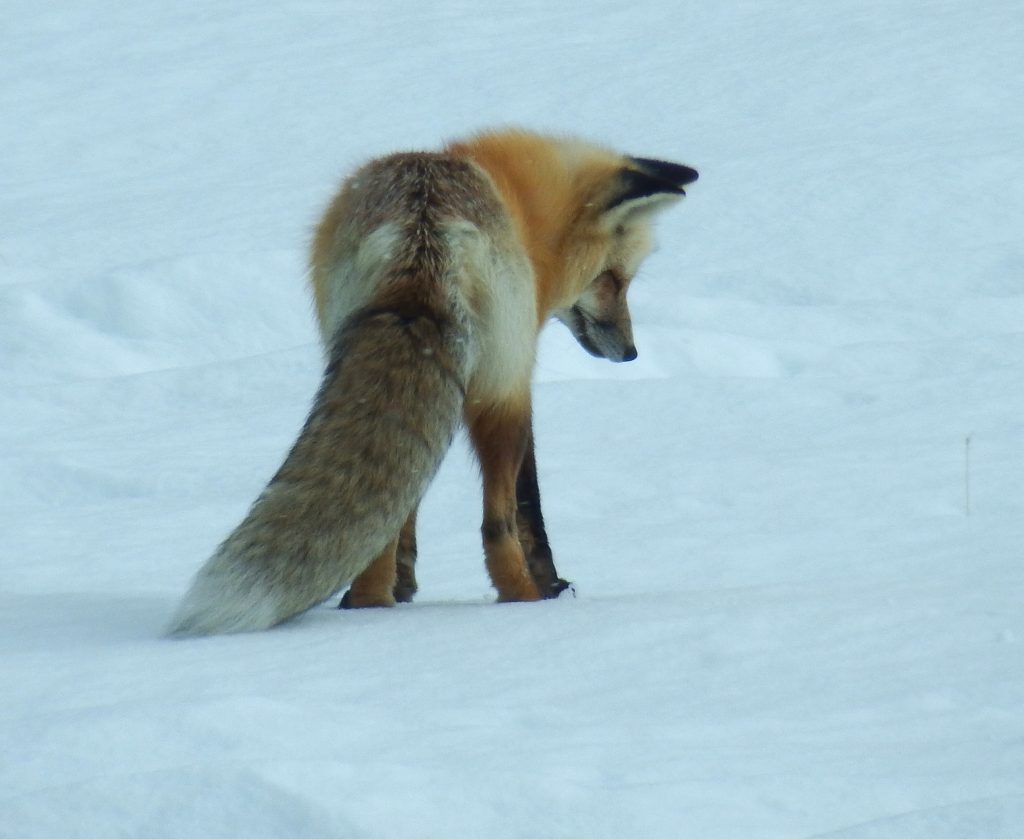
Fox looking at the ground

Kira: Sometimes it’s handy to triangulate. You know, walk back and forth a bit getting your audience excited while also pinpointing the location of the gnawer underneath.

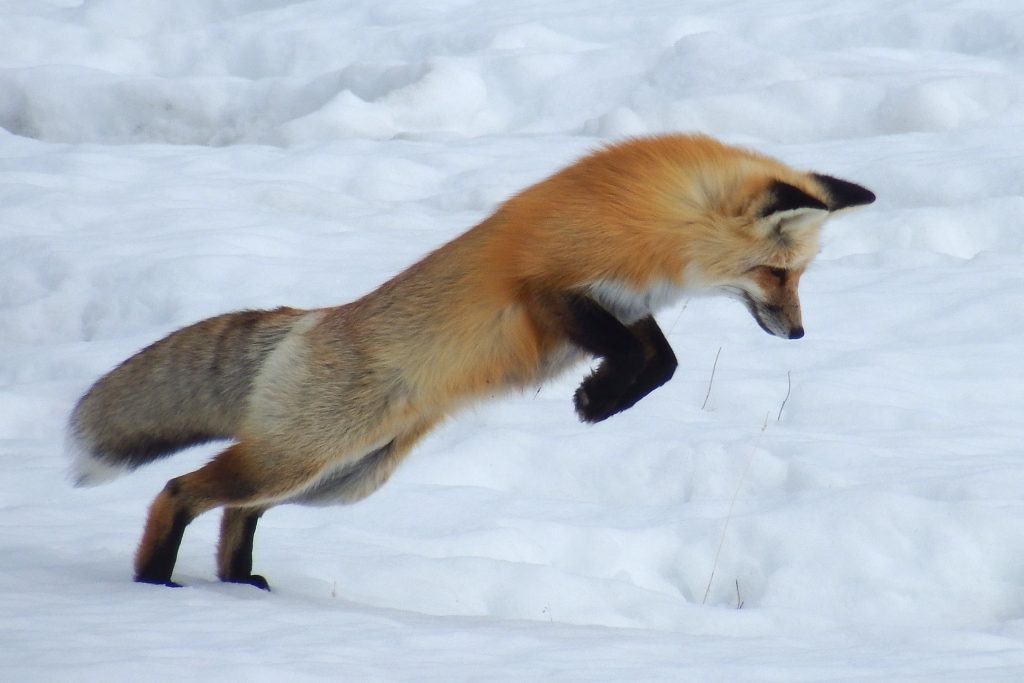
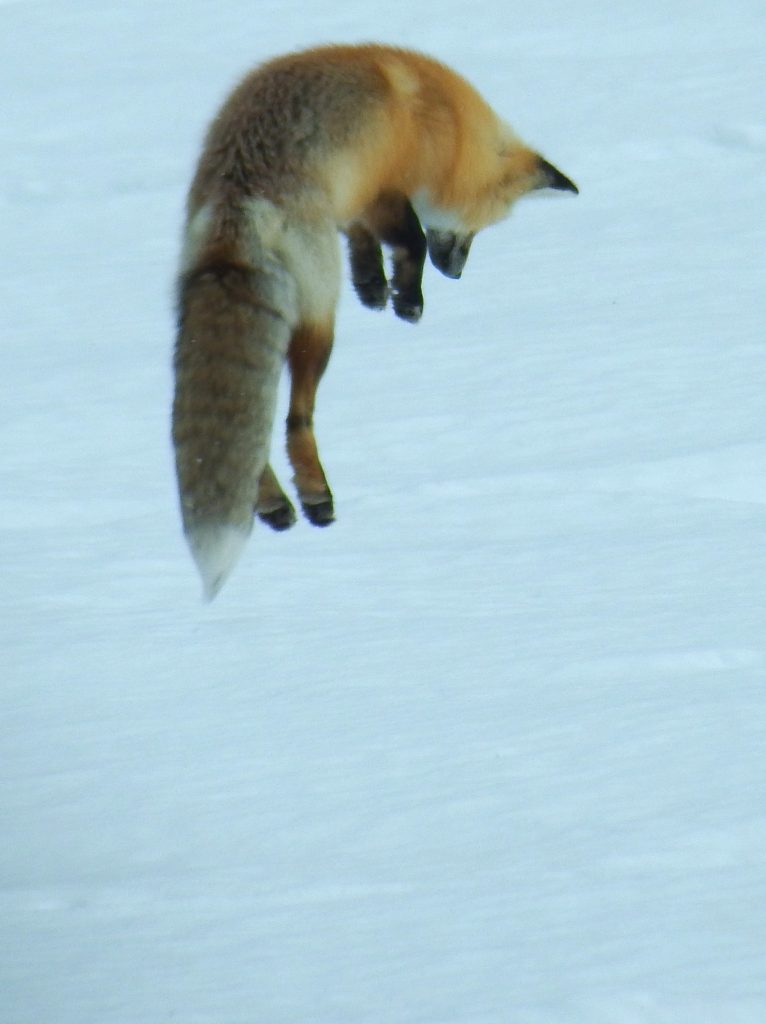
Pouncing fox

Kira: Then, when you’re ready, you leap…

Leaping fox

Kira: …up…

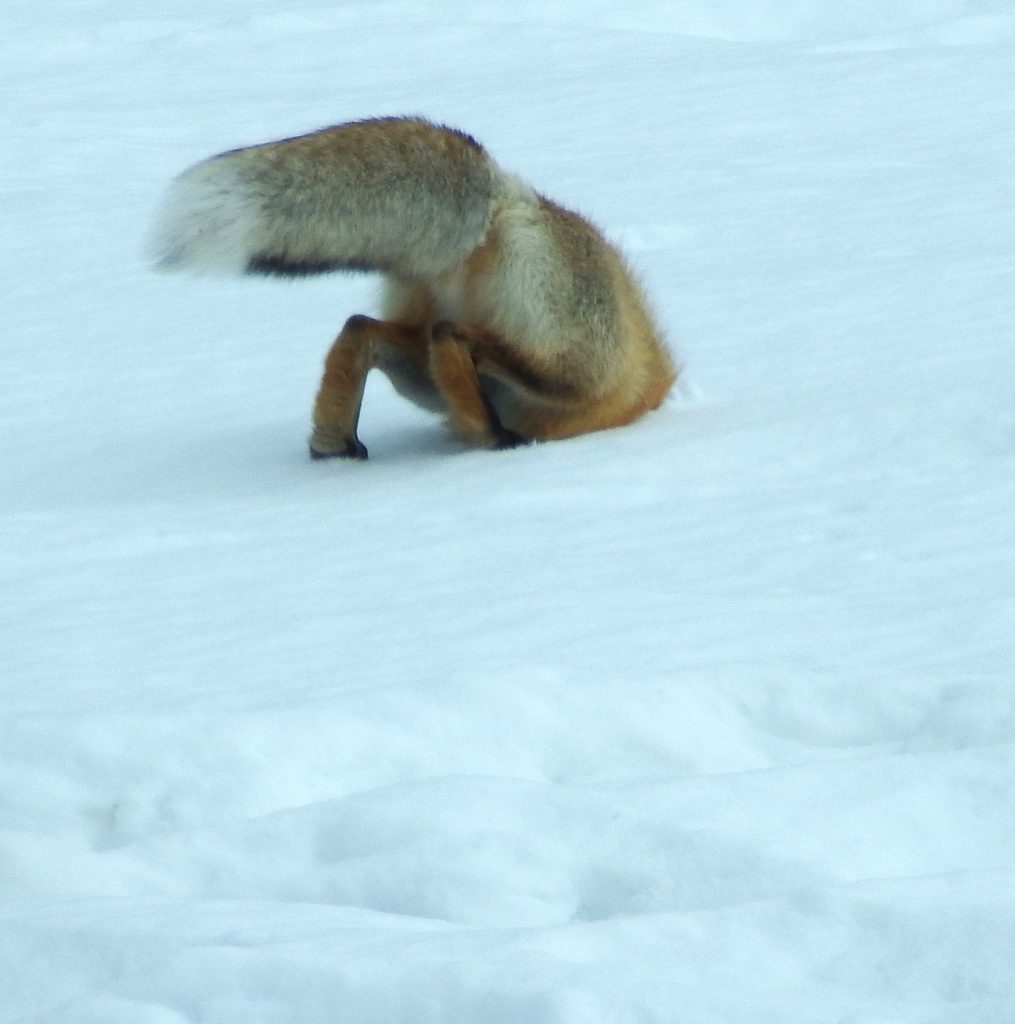
Fox in a hole

Kira: …and down…

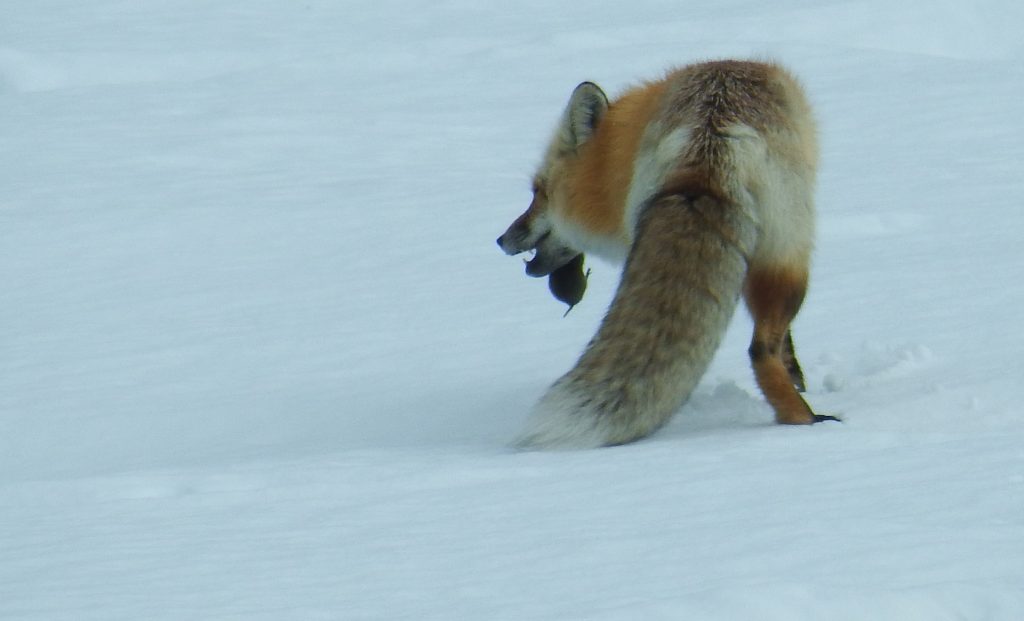
Fox eating a vole

Kira: …and grab it in your teeth. Three voles in twenty minutes. Score!

A fox in the willows

And that is the story of how a fox catches a vole. Stay tuned for more excitement as I delve deeper into my notes in the days to come!

Wanna chime in? I’d love to hear your comments on facebook:

Finding wild wolves in Yellowstone

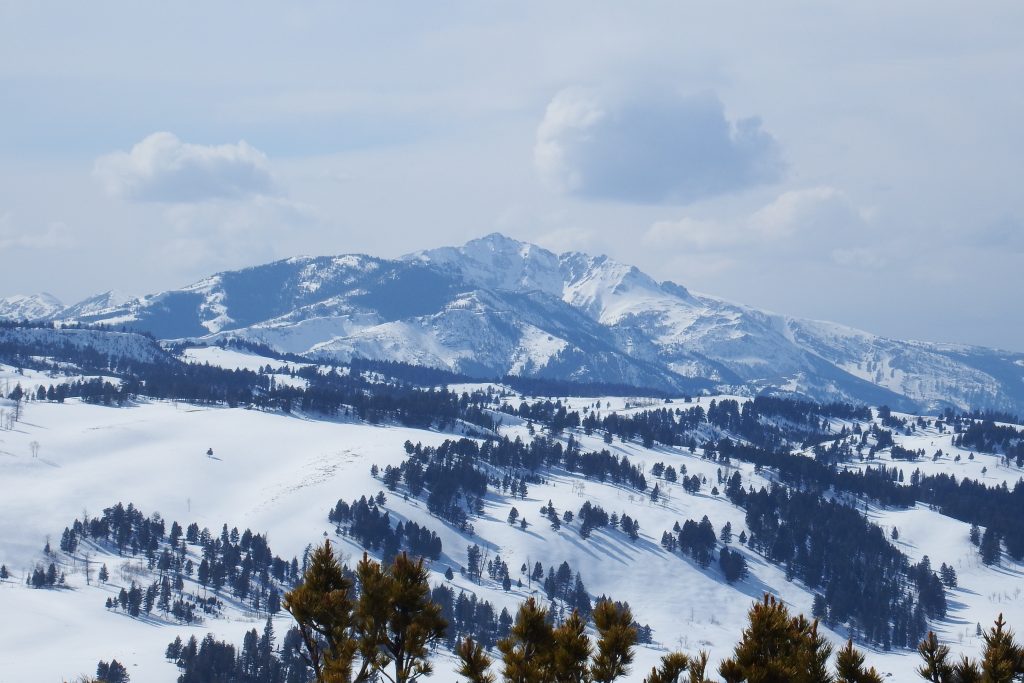
Yellowstone National Park

Today was our first full day in the park and we were on a mission — finding wolves. On the surface, this sounds utterly impossible. Currently, there are between 80 and 100 wolves living in the 3,741 square mile park. And, okay, so half of the eight packs live in the north range where we planned to be looking. Still — when we headed up into the mountains at dawn, the task felt reminiscent of seeking a needle in a haystack.

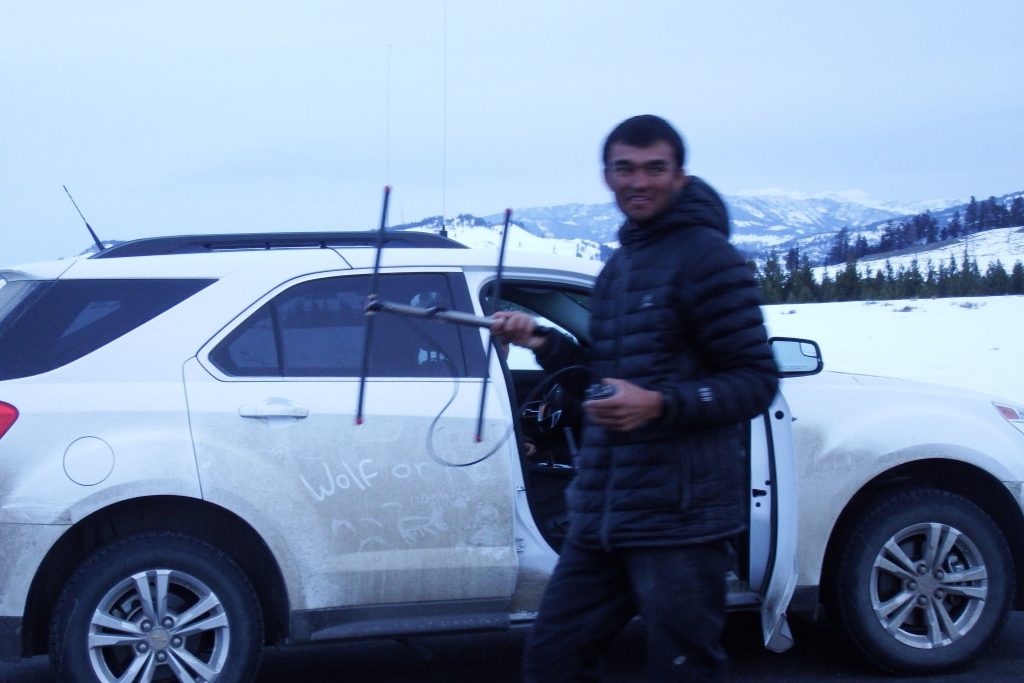
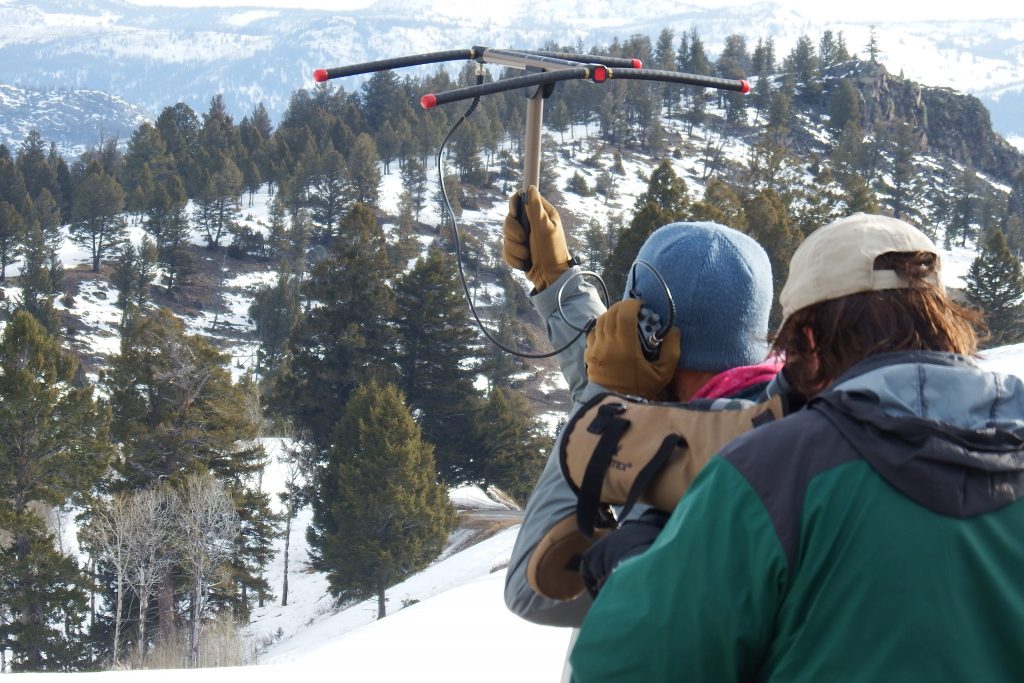
Tracking wolf radio signals

Enter the Wolf Project — a team of hard-core scientists who spend every daylight hour at this time of year tracking Yellowstone’s wolves. At least two wolves per pack wear radio collars that can be picked up as far as five miles away if the terrain is in your favor. On the other hand, if the wolves are hiding down in a ravine, you might not get a signal even if you’re only a mile out.

Yellowstone Wolf Project

Wolf Project did get a signal pretty quickly…but the wolves (Junction Butte Pack) were hiding in the trees. After hours of hopping from spot to spot on the road, setting up scopes, and seeing nothing, our fearless leader caught a glimpse of a lone gray wolf running across the snow…and then the wolf was gone before any of us could find it with eyes, binoculars, or scopes.

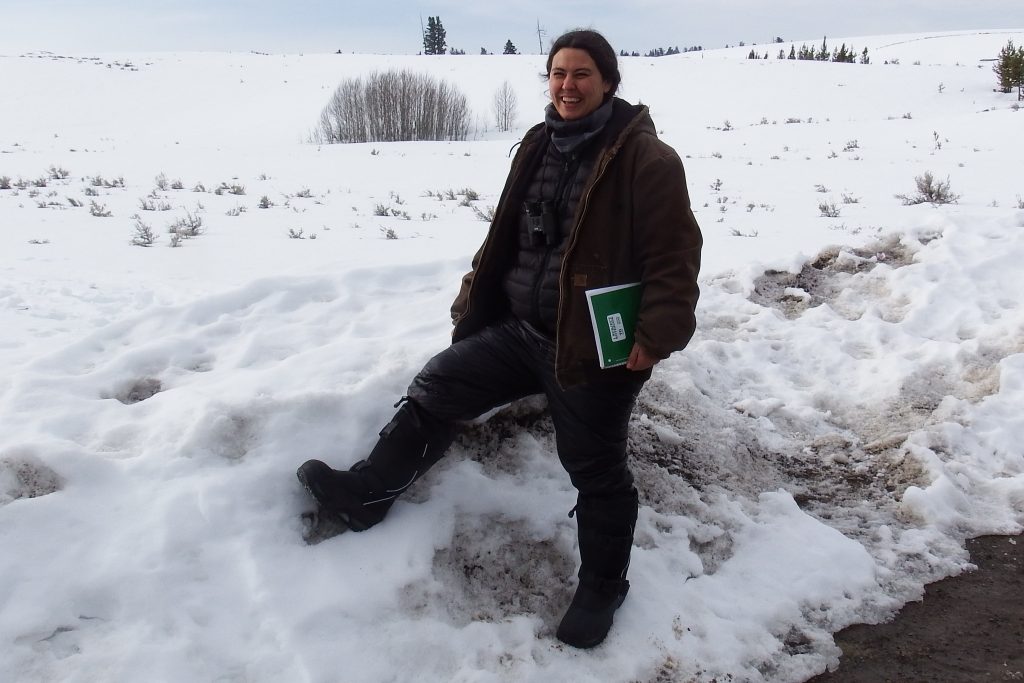
Dressed for winter wolf watching

I’ll admit to feeling a bit discouraged at this point. I was overdressed, having packed everything on the recommended list and worn two-thirds of it. Wool socks beneath -100 F boots. Long johns beneath down pants. Six layers on my torso and two on my hands. I was too hot for a hat even though others were stomping their feet at 19 degrees.

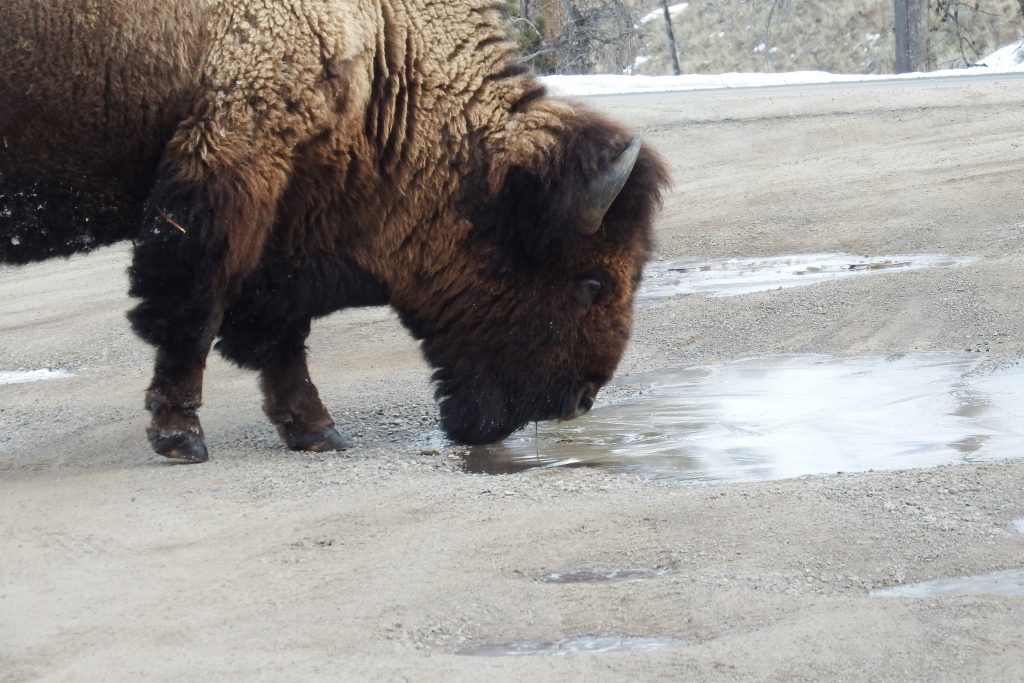
Buffalo drinking from a puddle

A bison reminded me how good I had it. He took a side trip into a parking area in search of water, breaking through the ice with his nose before drinking long and deep. Afterwards, perhaps spooked by our proximity, he left the pavement and sunk hip deep into the snow, struggling to move either forward or back.

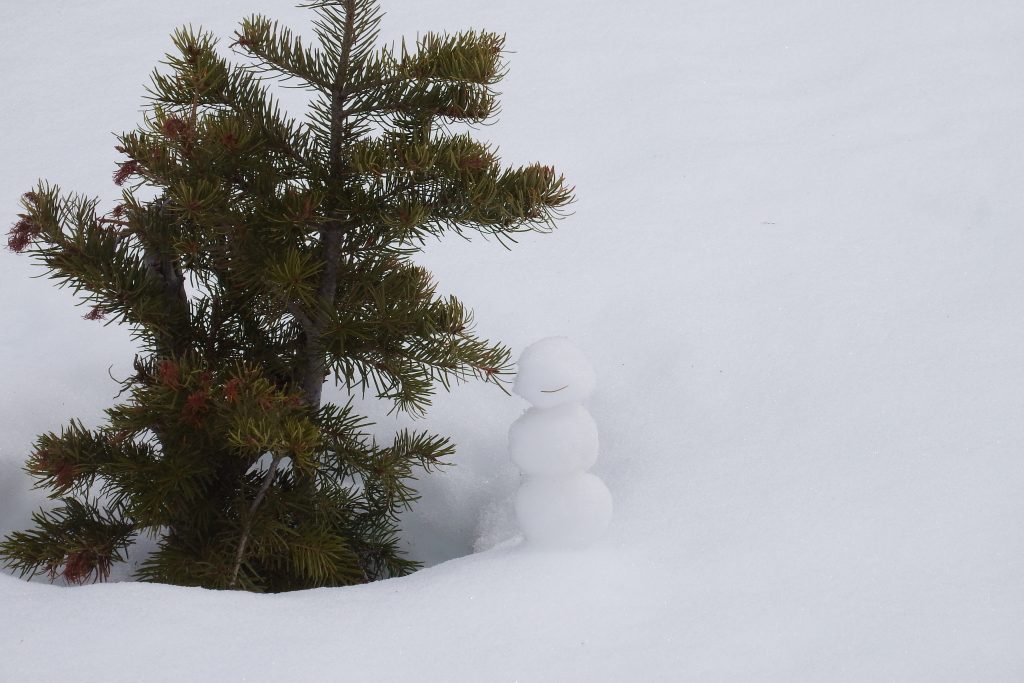
Mini snow man

Yes, this is foreshadowing. Pay attention.

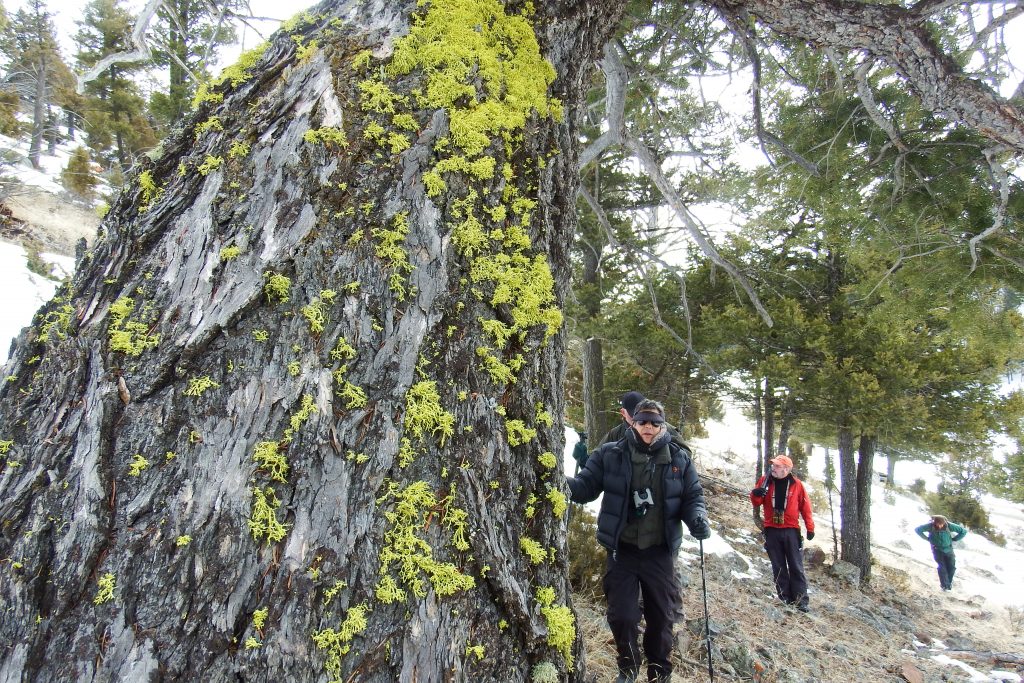
Yellowstone lichen

Anyway, back on the trail of the wolf we decided to leave the road and do a little postholing. What’s postholing, you ask?

Post holing

It’s when you walk on a crust of snow that occasionally drops you through into a knee-deep post hole. Then you’re faced with clawing your way out without disrupting the surface so much your other leg breaks through as well.

Suffice it to say, postholing is nothing like ambling down my usual woodland trails!

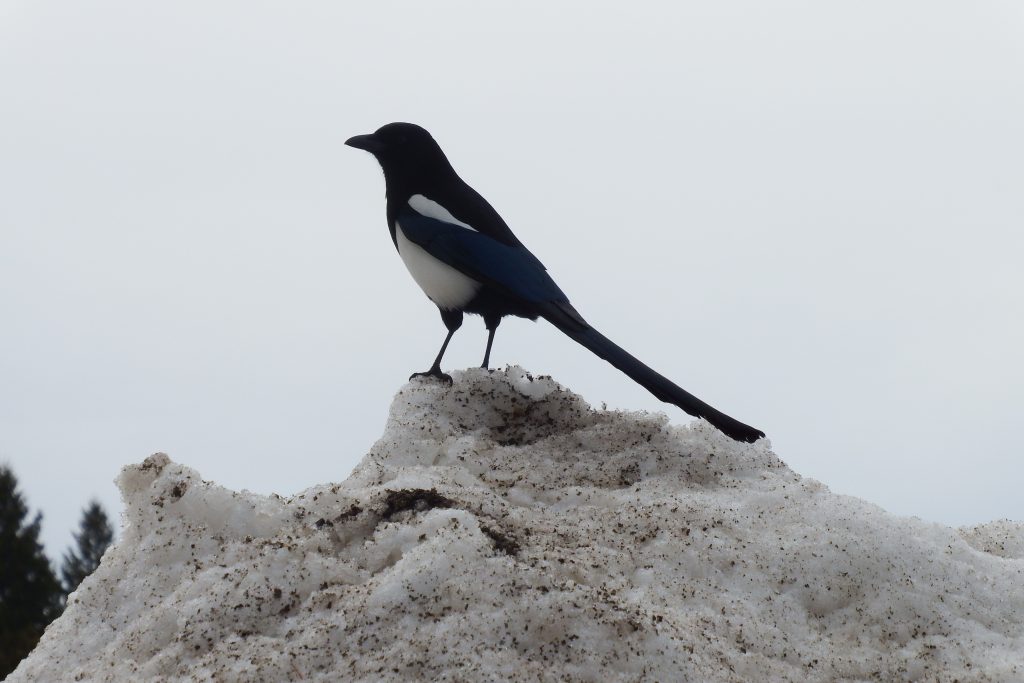
Magpie

Despite a bit of postholing, I thoroughly enjoyed our off-road excursion…but the wolves still refused to show. So we headed back to Mammoth for a delicious lunch and a bit of bird watching. This magpie is the picture my travel computer feels like posting, but we were also treated to magnificent views of a sleeping male great horned owl and his mate hidden deep in a nest of witch’s broom.

North Butte from a distance

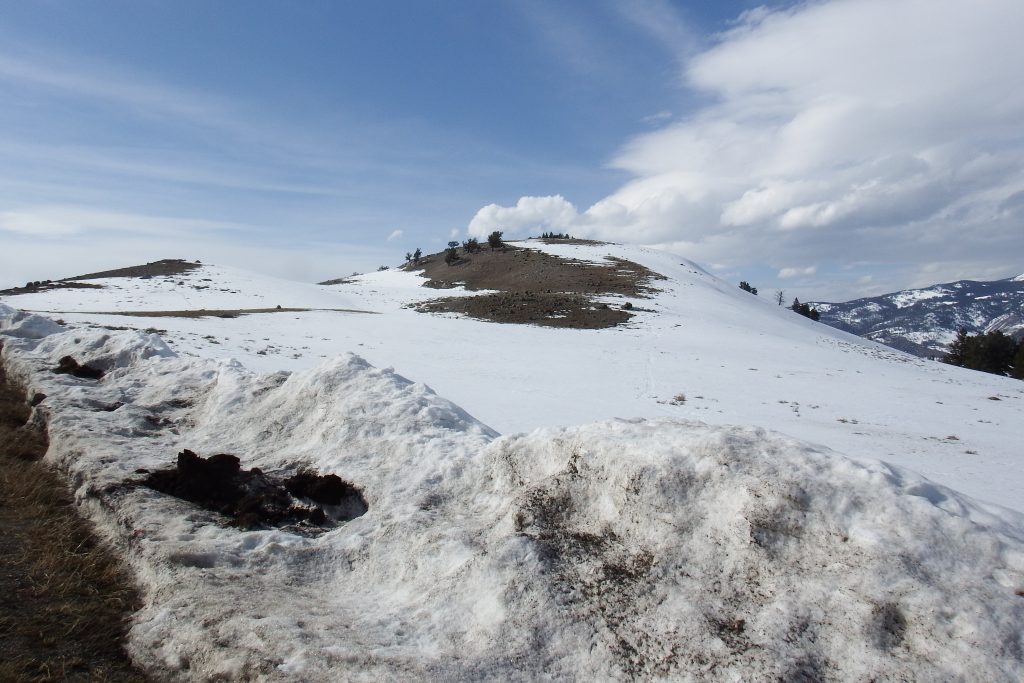
So, yes, there was lots of beauty and wildlife…but I wasn’t the only one who wanted to see wolves. So when our leader came to us with a decision — the 8 Mile Pack was on a kill and we could see it if we walked through a mile of rock and snow — I jumped at the chance to take part.

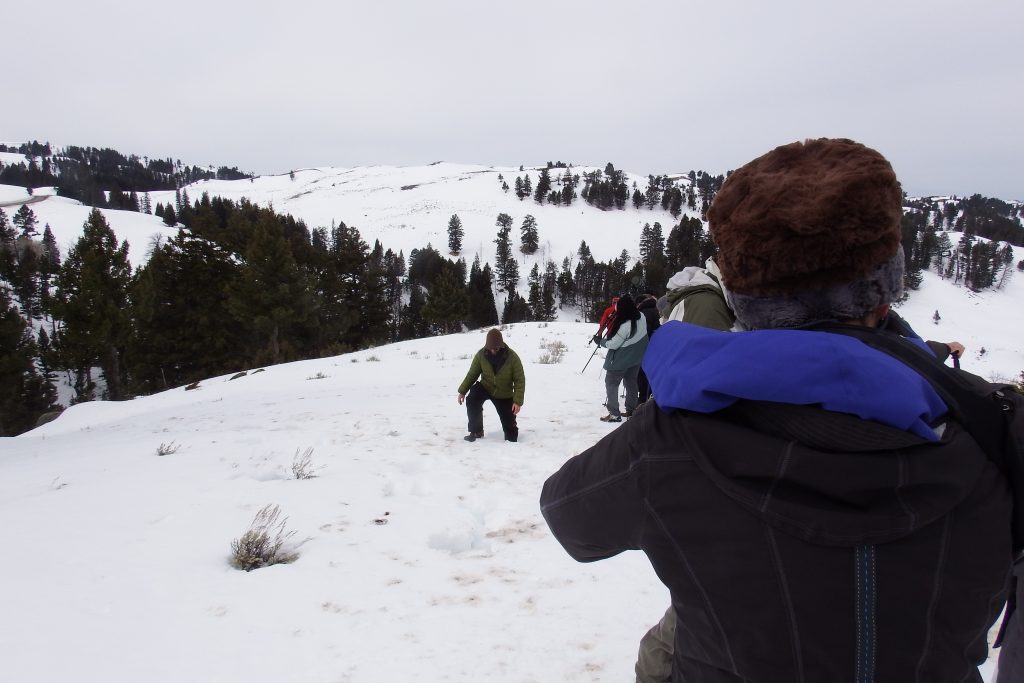
I was so gung-ho, in fact, that Mary (another wolf watcher) and I set out up the road toward North Butte before our trip leaders had finished handing out scopes and trekking poles. Only after we’d crested the little hill on the left did we look back…and realize the rest of the group was waving at us. We were headed the wrong way.

No problem. We’d cut across the snow to meet them. But the snow was deep — up to our hips in spots. And postholing was happening right and left.

One of my pack mates has a photo I may manage to add later. Taken from a distance, Mary and I are both waving our arms wildly as we attempt not to sink into the snow. But I have one leg submerged and she’s going down to.

Yes, this is why this section of the blog post has no photos. I was far to intent on survival to pull out the camera!

North Butte

At one point, I tried following a bison trail…but apparently I weigh more than a bison. Still, Mary and I pressed on, not smart enough to take turns breaking trail the way wolves do but instead spreading out in our own separate struggle.

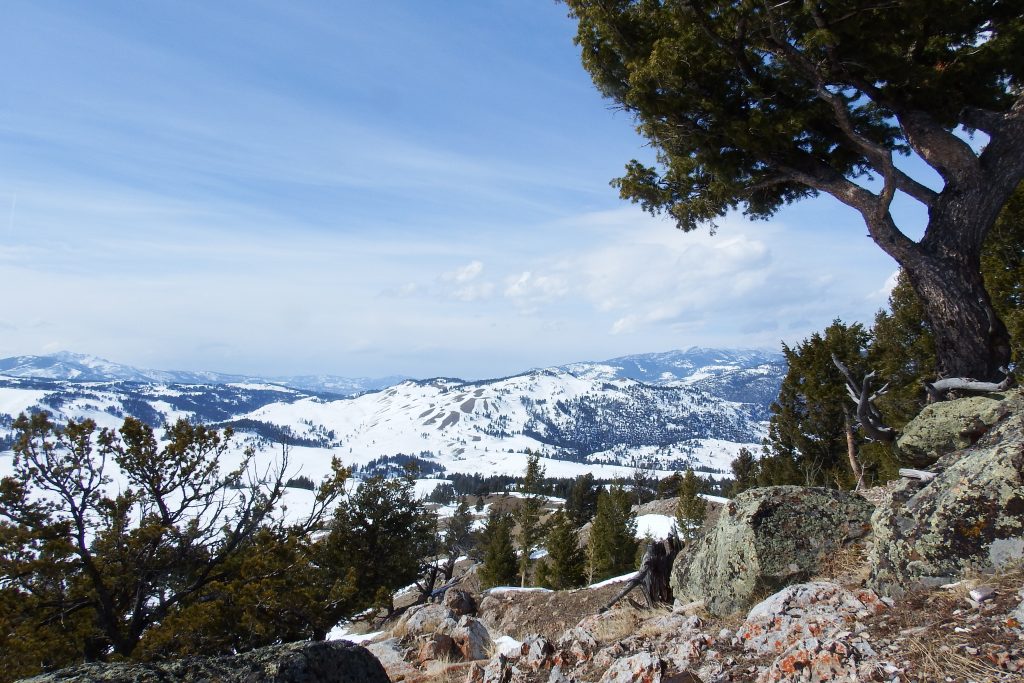
Eventually, huffing and puffing, we caught up to the group and continued climbing up the hill, through thin high elevation air, hoping the wolves weren’t gone.


Sleeping wolf pack

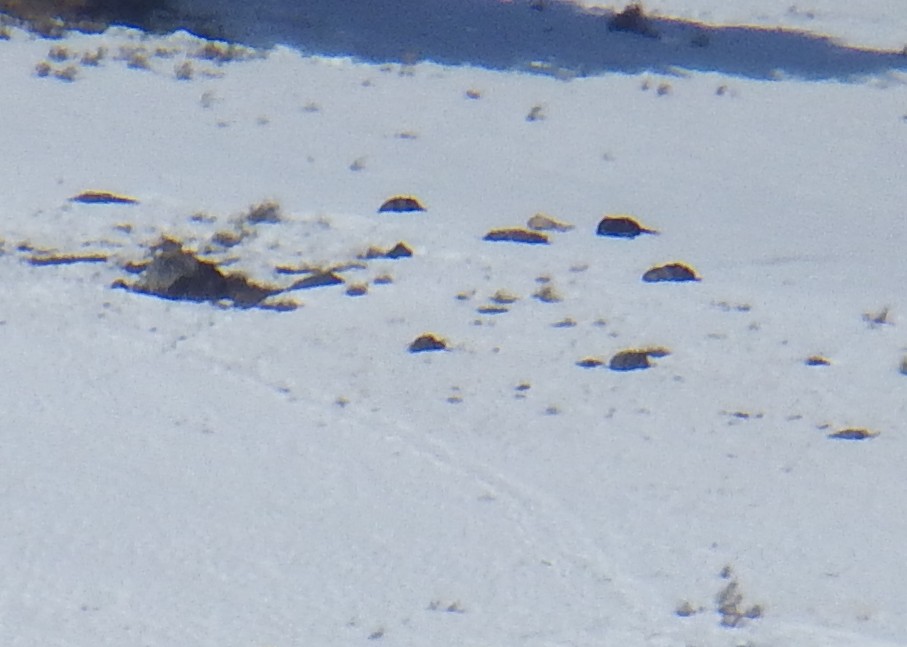
They weren’t! At the top, we set up scopes and found them, four black and two gray wolves lounging three hundred feet or so from the elk carcass they’d gorged upon that morning. Through binoculars, they looked like specks. Through the scopes, they looked like lumps.

Then one raised its head…and imagination filled in the blanks. The wolf was real and wild, seeming to peer across the mile of snowy ground that separated our two packs.

“Follow your alpha next time,” I imagined the wolf admonishing me and Mary. Nodding sagely, I lay back and listened to the wind rushing through the pine trees while soaking up my first wild wolf sighting.

And on the way back, Mary and I let our tour guide break trail.

Wanna chime in? I’d love to hear your comments on facebook:

Wolf Watching in Yellowstone: Day 1, charismatic megafauna

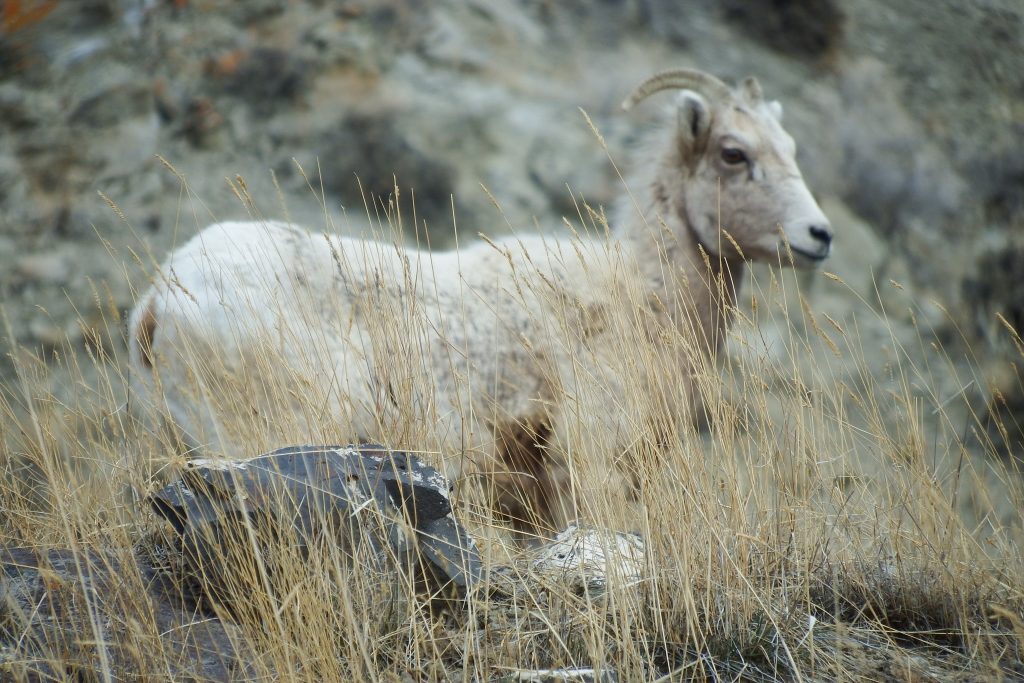
Bighorn sheep

I’m currently enjoying a once-in-a-lifetime adventure — a wolf-watching tour in Yellowstone National Park! I’d planned to save up a week’s worth of thoughts and photos and compile them into several thoughtful blog posts. But the truth is that at the end of day one, I’m just too excited not to share! So, come along with me on this afternoon’s cruise along Yellowstone River on the northwest corner of the park.

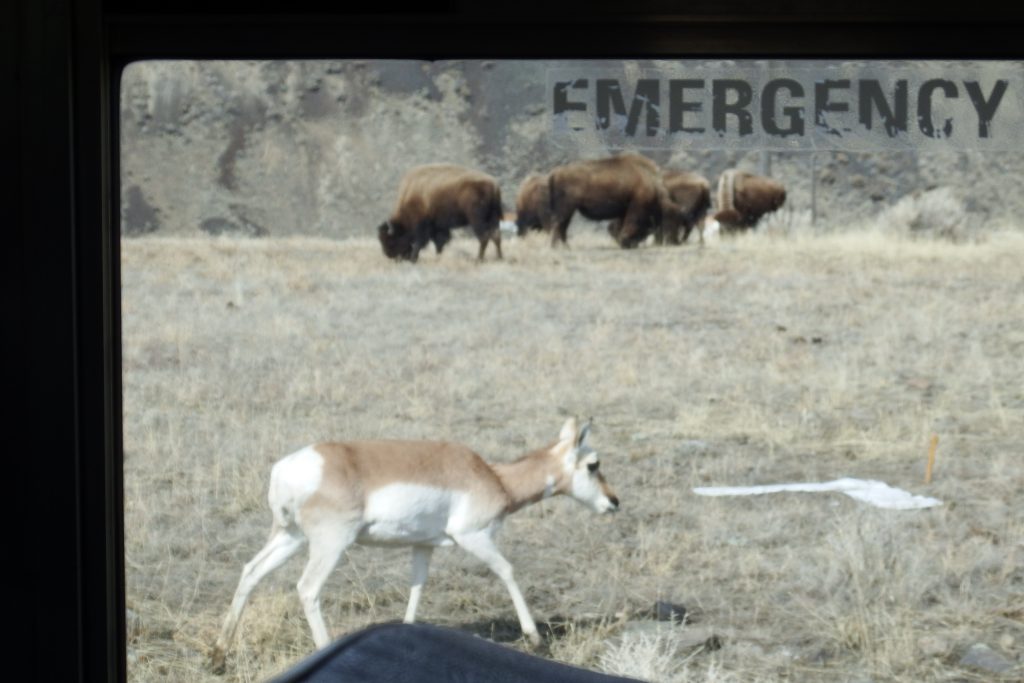
Pronghorn antelope and bison

If you had to guess which of the two species in this subpar photo (taken through the bus window) is considered lunch by wolves, which would it be? Bison or pronghorn antelope?

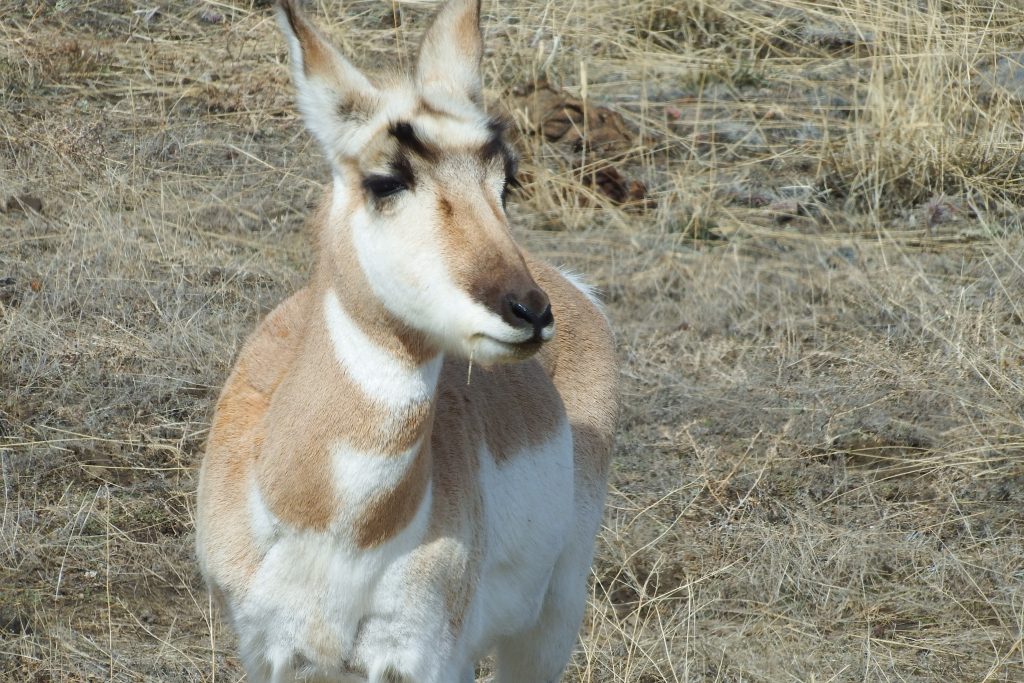
Pronghorn antelope

If you guessed the antelope, you were taken in by these ungulates’ mild appearance. Pronghorns co-evolved with a cheetah-like cat, and now that the ancient felines have bitten the dust nobody can outrun them. That’s right — pronghorn antelopes are too fast for wolves, capable of running up to 50 miles per hour and clocking in as North America’s fastest living land mammal. In contrast, wolves tend to top out in the high 30s mph.
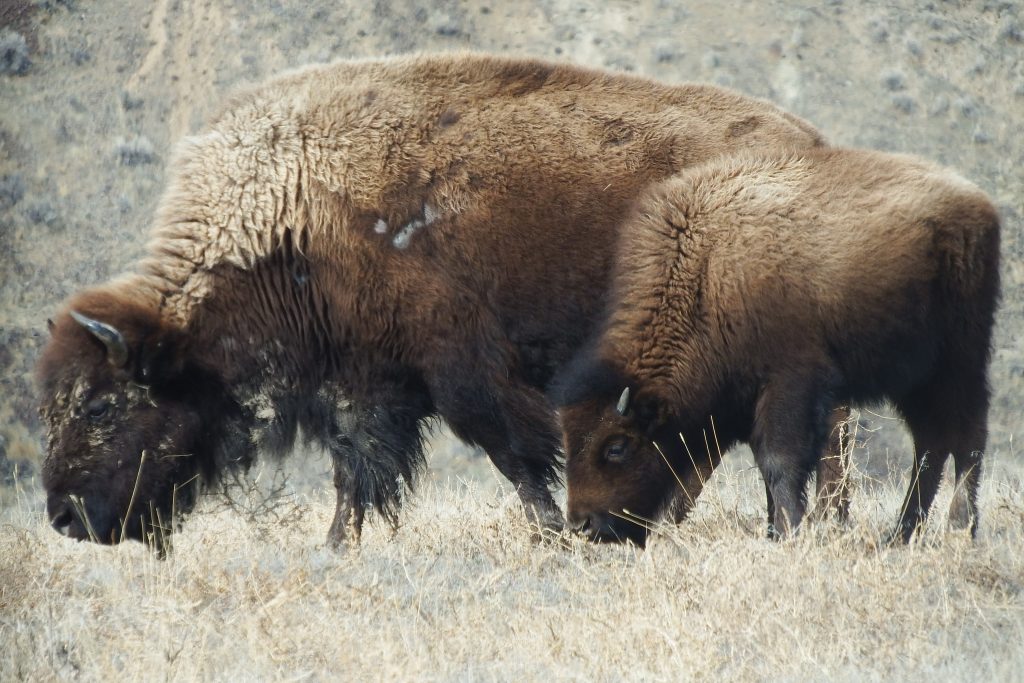
Bison
Bison, on the other hand, can be taken by wolves, especially if a pack can drive the lumbering beasts into dense snow. In fact, there have been sightings of single wolves taking down a bison, although it can be a multiple-hour-long battle. Sometimes it’s better to be fast than big.

Elk

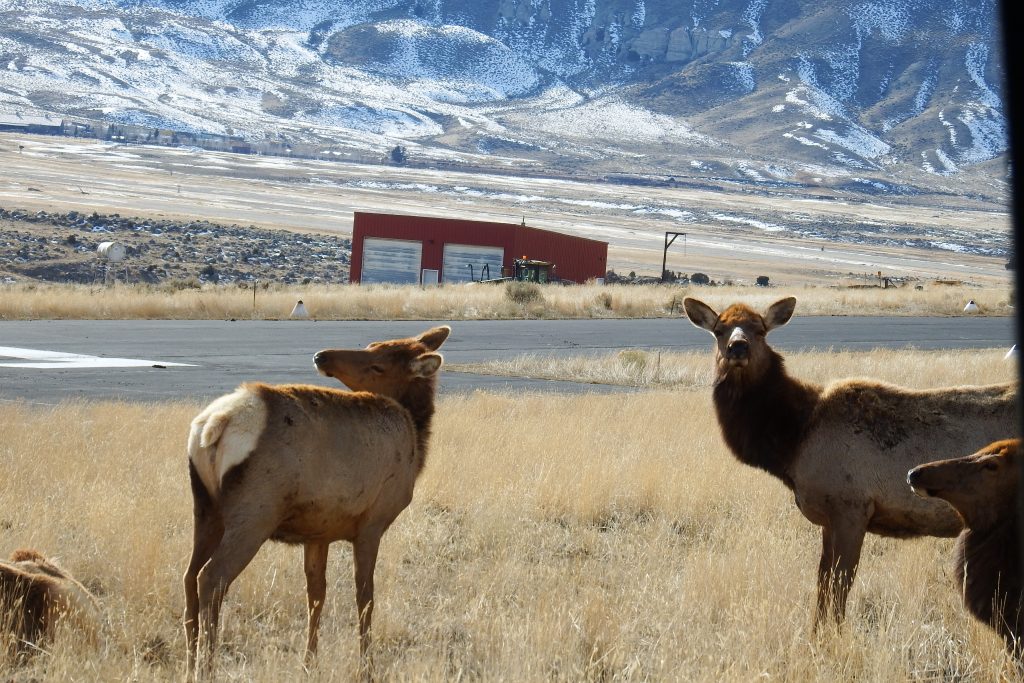
Of course, a wolf’s favorite food is neither of those species. Here in Yellowstone, a happy wolf is a wolf with access to elk. Given that there are only 80 to 100 wolves in Yellowstone at the moment but approximately 7,000 to 8,000 elk, the packs have a pretty good shot at finding dinner.

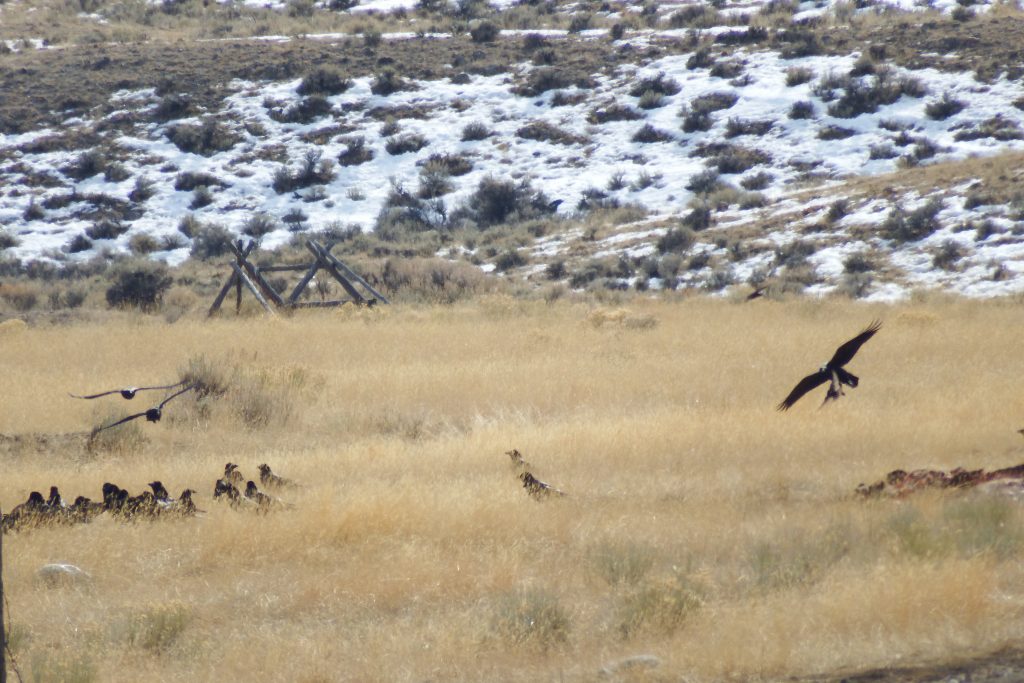
Ravens on a carcass

Or rather, breakfast. We arrived far too late in the day to get a chance at spotting wolves on day one, although we did see some of their frequent companions — ravens — nibbling on a human-killed bison carcass. Did you know that some scientists think ravens lead wolves to sick or dead animals, hoping for help ripping through tough hides so both can feast together?

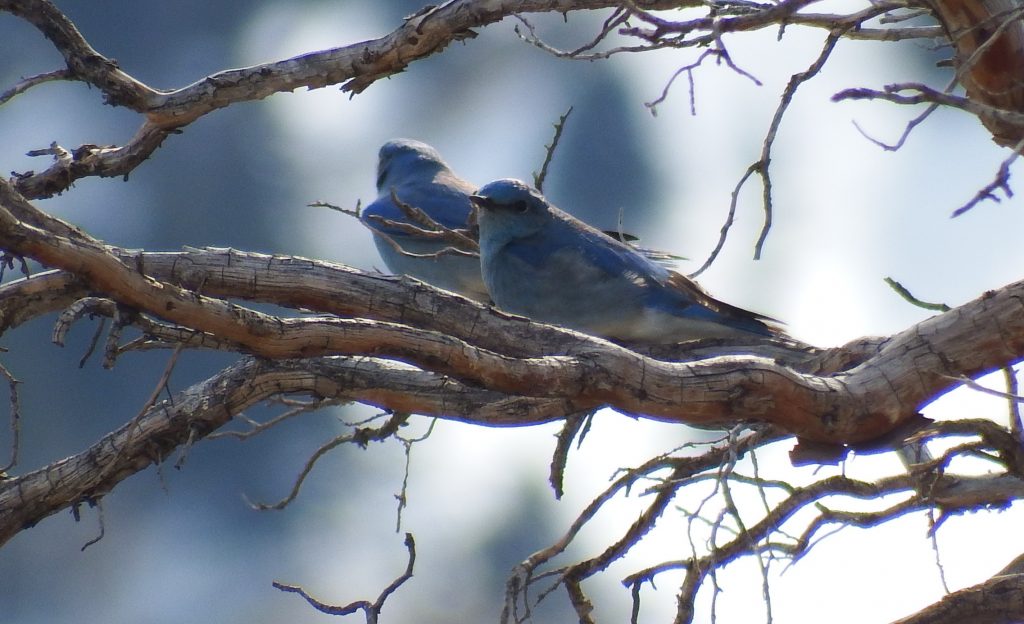
Mountain Bluebirds

Tomorrow, I hope, there will be more beauty — like these Mountain Bluebirds — and also our first sighting of wolves. Fingers crossed!

Wanna chime in? I’d love to hear your comments on facebook!

© 2026 Aimee Easterling

Theme by Anders NorenUp ↑